
Topological Sort
Overview
The Topological Sort algorithm produces an ordering of nodes in a directed acyclic graph (DAG) such that for every edge, the source node appears before the target node. It uses Kahn's algorithm, processing nodes level by level from source nodes (in-degree 0).
Topological sorting is widely used for dependency resolution, task scheduling, and build ordering.
Concepts
Directed Acyclic Graph (DAG)
A directed acyclic graph (DAG) is a directed graph with no directed cycles. That is, it is not possible to start at any node v and follow a directed path to return back to v.
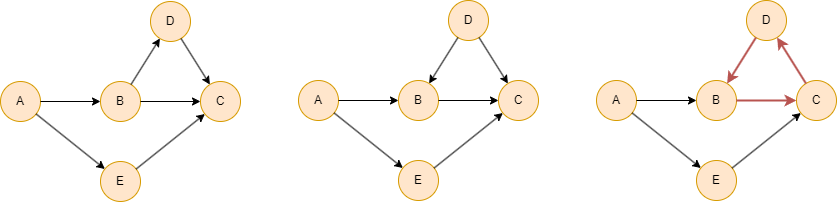
As shown here, the first and second graphs are DAGs, while the third graph contains a directed cycle (B→C→D→B) and therefore does not qualify as a DAG.
A directed graph is a DAG if and only if it can be topologically sorted.
Topological Sort
Every DAG has at least one topological sorting. In the above examples, the first graph has 3 possible sortings:
A, E, B, D, CA, B, E, D, CA, B, D, E, C
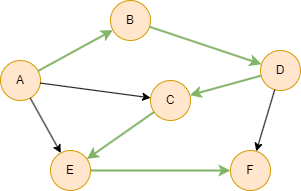
A DAG has a unique topological sorting if and only if it has a directed path containing all the nodes, in which case the sorting is the same as the order in which the nodes appear in the path.
In the following example, the nodes have only 1 possible topological sorting: A, B, D, C, E, F.
Considerations
- The algorithm only works on directed acyclic graphs (DAGs). If the graph contains a cycle, an error is returned.
- Each node is assigned a
levelbased on its BFS depth from source nodes (nodes with in-degree 0 are level 0).
Example Graph

GQLINSERT (A:default {_id: "A"}), (B:default {_id: "B"}),
       (C:default {_id: "C"}), (D:default {_id: "D"}),
       (E:default {_id: "E"}), (F:default {_id: "F"}),
       (G:default {_id: "G"}), (H:default {_id: "H"}),
       (A)-[:default]->(B), (A)-[:default]->(C),
       (A)-[:default]->(D), (A)-[:default]->(E),
       (E)-[:default]->(G), (F)-[:default]->(D),
       (F)-[:default]->(E), (H)-[:default]->(G)
Parameters
| Name | Type | Default | Description |
|---|---|---|---|
limit | INT | -1 | Limits the number of results returned (-1 = all). |
order | STRING | / | Sorts the results by order: asc or desc. |
Run Mode
Returns:
| Column | Type | Description |
|---|---|---|
nodeId | STRING | Node identifier (_id) |
order | INT | Topological order position (0-based) |
level | INT | BFS level in the DAG (0 = source nodes) |
GQLCALL algo.topologicalsort() YIELD nodeId, order, level
Result:
| nodeId | order | level |
|---|---|---|
| F | 0 | 0 |
| A | 1 | 0 |
| H | 2 | 0 |
| E | 3 | 1 |
| D | 4 | 1 |
| C | 5 | 1 |
| B | 6 | 1 |
| G | 7 | 2 |
Stream Mode
Returns the same columns as run mode, streamed for memory efficiency.
GQLCALL algo.topologicalsort.stream() YIELD nodeId, order, level
FILTER level = 0
RETURN nodeId
Result:
| nodeId |
|---|
| F |
| A |
| H |
Stats Mode
Returns:
| Column | Type | Description |
|---|---|---|
nodeCount | INT | Total number of nodes |
maxLevel | INT | Maximum BFS level in the DAG |
GQLCALL algo.topologicalsort.stats() YIELD nodeCount, maxLevel
Result:
| nodeCount | maxLevel |
|---|---|
| 8 | 2 |