
Conductance
Overview
Conductance is a metric used to evaluate the quality of a community or cluster within a graph. Studies have shown that scoring functions that are based on conductance best capture the structure of ground-truth communities.
- J. Yang, J. Leskovec, Defining and Evaluating Network Communities based on Ground-truth (2012)
Concepts
Conductance
Intuitively, a good community should have strong internal connections and only weak connections to the rest of the graph.
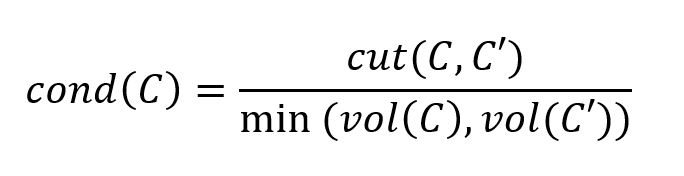
For a community C and its complement C', the conductance of C is defined as the ratio of the cut size (the number of edges crossing between C and C') to the minimum volume of C and C' (i.e., the sum of degrees of nodes within each set):
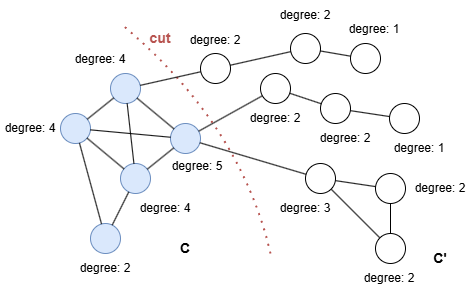
In the example below, the community C is connected to the rest of the graph with three edges, i.e., cut(C, C') = 3. The conductance of C is then cond(C) = 3/min(19, 17) = 3/17 = 0.176471.
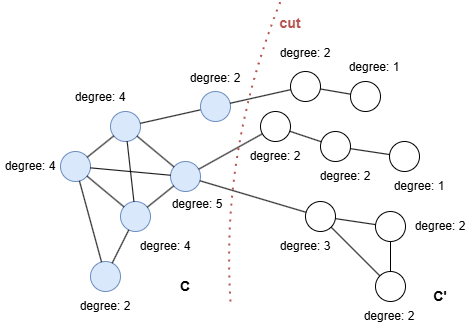
If we adjust the cut to include one more node in C, the conductance becomes cond(C) = 3/min(21, 15) = 3/15 = 0.2.
A small conductance value is desirable in community detection because it indicates a dense community with relatively few edges connecting to the outside. Conversely, a large conductance value means the community is loosely connected internally and has many edges reaching nodes outside the community.
Example Graph
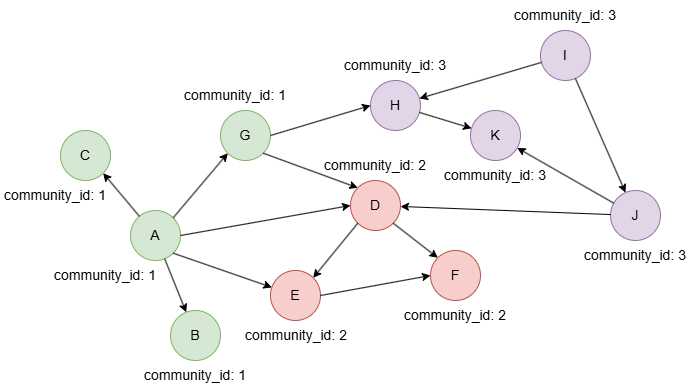
GQLINSERT (A:default {_id: "A", community_id: 1}), (B:default {_id: "B", community_id: 1}),
       (C:default {_id: "C", community_id: 1}), (D:default {_id: "D", community_id: 2}),
       (E:default {_id: "E", community_id: 2}), (F:default {_id: "F", community_id: 2}),
       (G:default {_id: "G", community_id: 1}), (H:default {_id: "H", community_id: 3}),
       (I:default {_id: "I", community_id: 3}), (J:default {_id: "J", community_id: 3}),
       (K:default {_id: "K", community_id: 3}),
       (A)-[:default]->(B), (A)-[:default]->(C),
       (A)-[:default]->(D), (A)-[:default]->(E),
       (A)-[:default]->(G), (D)-[:default]->(E),
       (D)-[:default]->(F), (E)-[:default]->(F),
       (G)-[:default]->(D), (G)-[:default]->(H),
       (H)-[:default]->(K), (I)-[:default]->(H),
       (I)-[:default]->(J), (J)-[:default]->(D),
       (J)-[:default]->(K)
Parameters
| Name | Type | Default | Description |
|---|---|---|---|
communityProperty | STRING | / | Node property name storing community assignment. |
Run Mode
Returns:
| Column | Type | Description |
|---|---|---|
community | INT | Community identifier |
conductance | FLOAT | Conductance score (lower is better) |
volume | FLOAT | Volume of the community (sum of degrees) |
cut | FLOAT | Cut size (edges crossing community boundary) |
GQLCALL algo.conductance({
  communityProperty: "community_id"
}) YIELD community, conductance, volume, cut
Result:
| community | conductance | volume | cut |
|---|---|---|---|
| 3 | 0.2 | 10 | 2 |
| 2 | 0.4 | 10 | 4 |
| 1 | 0.4 | 10 | 4 |
Stream Mode
Returns the same columns as run mode, streamed for memory efficiency.
GQLCALL algo.conductance.stream({
  communityProperty: "community_id"
}) YIELD community, conductance
RETURN community, conductance
Result:
| community | conductance |
|---|---|
| 2 | 0.4 |
| 1 | 0.4 |
| 3 | 0.2 |
Stats Mode
Returns:
| Column | Type | Description |
|---|---|---|
nodeCount | INT | Total number of nodes |
communityCount | INT | Number of communities |
avgConductance | FLOAT | Average conductance across communities |
minConductance | FLOAT | Minimum conductance value |
maxConductance | FLOAT | Maximum conductance value |
GQLCALL algo.conductance.stats({
  communityProperty: "community_id"
}) YIELD nodeCount, communityCount, avgConductance, minConductance, maxConductance
Result:
| nodeCount | communityCount | avgConductance | minConductance | maxConductance |
|---|---|---|---|---|
| 11 | 3 | 0.3333333333333333 | 0.2 | 0.4 |