
Betweenness Centrality
Overview
Betweenness centrality measures the likelihood of a node being on the shortest paths between any two other nodes. This metric effectively identifies "bridge" nodes that facilitate connectivity between different parts of a graph.
Betweenness centrality scores range from 0 to 1 (when normalized), with higher scores indicating nodes that exert greater influence over the flow and connectivity of the network.
References:
- L.C. Freeman, A Set of Measures of Centrality Based on Betweenness (1977)
- L.C. Freeman, Centrality in Social Networks Conceptual Clarification (1978)
Concepts
Shortest Path
The shortest paths between two nodes are the paths that contain the fewest edges. When considering edge weights, the (weighted) shortest paths are those with the lowest total weight sum.
Betweenness Centrality
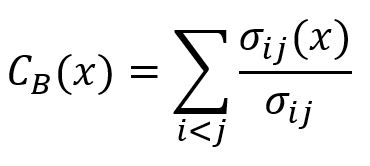
The betweenness centrality of a node x is computed by:
where,
iandjare two distinct nodes in the graph, excludingx.σijis the total number of shortest paths betweeniandj.σij(x)is the number of shortest paths betweeniandjthat pass through nodex.σij(x)/σijgives the probability thatxlies in the shortest paths betweeniandj. Note that ifiandjare not connected,σij(x)/σijis 0.
The final value is normalized by the factor (k – 1)(k – 2), where k is the total number of nodes in the graph. This normalization ensures the result lies within a fixed range, making it comparable across graphs of different sizes.
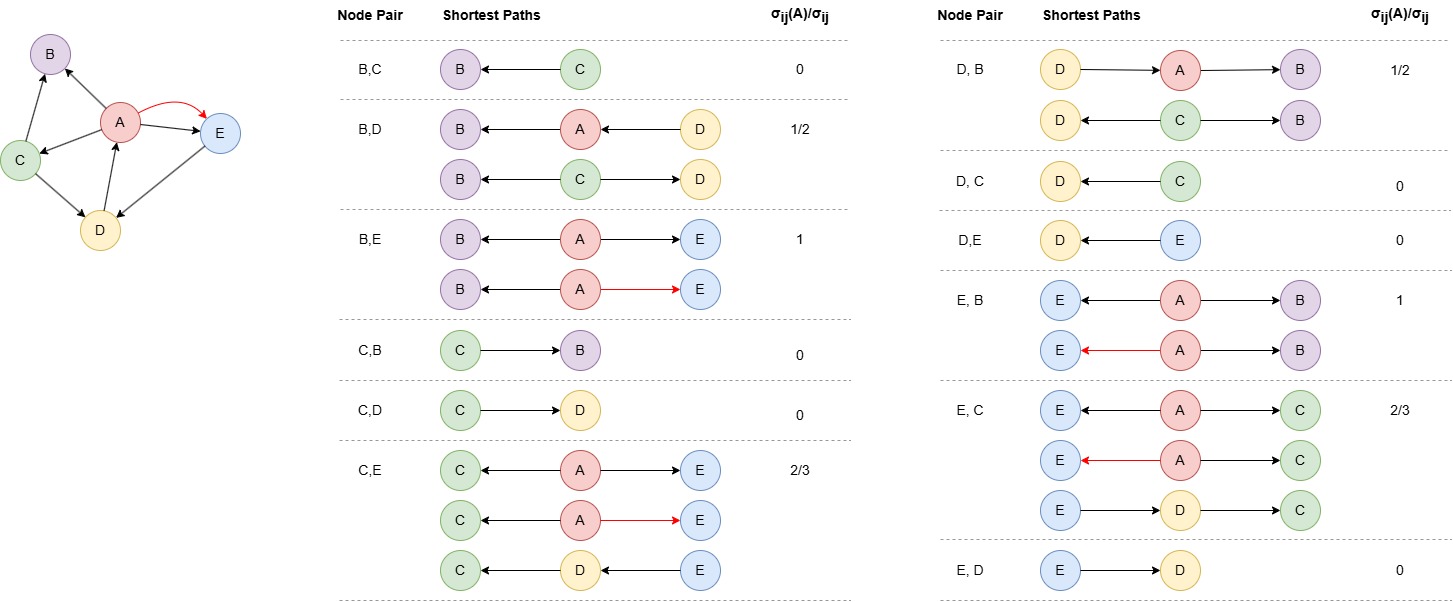
The betweenness centrality of node A is computed as: (1/2 + 1 + 2/3 + 1/2 + 1 + 2/3) / (4 * 3) = 0.3611111111.
Example Graph
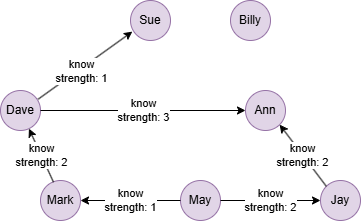
GQLINSERT (Sue:user {_id: "Sue"}), (Dave:user {_id: "Dave"}),
       (Ann:user {_id: "Ann"}), (Mark:user {_id: "Mark"}),
       (May:user {_id: "May"}), (Jay:user {_id: "Jay"}),
       (Billy:user {_id: "Billy"}),
       (Dave)-[:know {strength: 1}]->(Sue), (Dave)-[:know {strength: 3}]->(Ann),
       (Mark)-[:know {strength: 2}]->(Dave), (May)-[:know {strength: 1}]->(Mark),
       (May)-[:know {strength: 2}]->(Jay), (Jay)-[:know {strength: 2}]->(Ann)
Parameters
| Name | Type | Default | Description |
|---|---|---|---|
ids | LIST | / | _ids of nodes to compute (empty = all nodes). |
direction | STRING | both | Edge direction: in, out, or both. |
normalized | BOOL | false | Whether to normalize scores to [0, 1]. |
weight | STRING or LIST | / | Numeric edge property for weighted shortest paths. |
samplingSize | INT | -1 | Number of source nodes to sample (-1 = all). Recommended for large graphs. |
limit | INT | -1 | Limits the number of results returned (-1 = all). |
order | STRING | / | Sorts the results by score: asc or desc. |
Run Mode
Returns:
| Column | Type | Description |
|---|---|---|
nodeId | STRING | Node identifier (_id) |
score | FLOAT | Betweenness centrality score |
rank | INT | Rank position (1 = highest betweenness) |
Normalized betweenness centrality for all nodes:
GQLCALL algo.betweenness({
  normalized: true,
  order: "desc"
}) YIELD nodeId, score, rank
Result:
| nodeId | score | rank |
|---|---|---|
| Dave | 0.3333333333333333 | 1 |
| Mark | 0.13333333333333333 | 2 |
| Ann | 0.13333333333333333 | 3 |
| May | 0.06666666666666667 | 4 |
| Jay | 0.06666666666666667 | 5 |
| Sue | 0 | 6 |
| Billy | 0 | 7 |
Weighted betweenness centrality:
GQLCALL algo.betweenness({
  ids: ["Dave"],
  normalized: true,
  weight: ["strength"]
}) YIELD nodeId, score, rank
Result:
| nodeId | score | rank |
|---|---|---|
| Dave | 0.3 | 1 |
Stream Mode
Returns the same columns as run mode, streamed for memory efficiency.
GQLCALL algo.betweenness.stream({
  normalized: true,
  order: "desc"
}) YIELD nodeId, score
FILTER score > 0.1
RETURN nodeId, score
Result:
| nodeId | score |
|---|---|
| Dave | 0.3333333333333333 |
| Mark | 0.13333333333333333 |
| Ann | 0.13333333333333333 |
Stats Mode
Returns:
| Column | Type | Description |
|---|---|---|
nodeCount | INT | Total number of nodes |
minScore | FLOAT | Minimum betweenness score |
maxScore | FLOAT | Maximum betweenness score |
avgScore | FLOAT | Average betweenness score |
GQLCALL algo.betweenness.stats({normalized: true}) YIELD nodeCount, minScore, maxScore, avgScore
Result:
| nodeCount | minScore | maxScore | avgScore |
|---|---|---|---|
| 7 | 0 | 0.3333333333333333 | 0.1047619047619048 |
Write Mode
Computes results and writes them back to node properties. The write configuration is passed as a second argument map.
Write parameters:
| Name | Type | Description |
|---|---|---|
db.property | STRING or MAP | Node property to write results to. String: writes the score column in results to a property. Map: explicit column-to-property mapping (e.g., {score: 'bc_score', rank: 'bc_rank'}). |
Writable columns:
| Column | Type | Description |
|---|---|---|
score | FLOAT | Betweenness centrality score |
rank | INT | Rank position |
Returns:
| Column | Type | Description |
|---|---|---|
task_id | STRING | Task identifier for tracking via SHOW TASKS |
nodesWritten | INT | Number of nodes with properties written |
computeTimeMs | INT | Time spent computing the algorithm (milliseconds) |
writeTimeMs | INT | Time spent writing properties to storage (milliseconds) |
GQLCALL algo.betweenness.write({normalized: true}, {
  db: {
    property: "bc_score"
  }
}) YIELD task_id, nodesWritten, computeTimeMs, writeTimeMs