
Breadth-First Search (BFS)
Overview
Graph traversal is a search technique used to systematically visit and explore all the nodes in a graph. Its primary goal is to reveal and examine the structure and connections of the graph. There are two common strategies for graph traversal:
- Breadth-First Search (BFS)
- Depth-First Search (DFS)
The BFS algorithm explores a graph level by level and proceeds as follows:
- Create a queue (first in, first out) to keep track of visited nodes.
- Start from a selected node, enqueue it and mark as visited.
- Dequeue a node from the front of the queue, enqueue all its unvisited neighbors into the queue and mark them as visited.
- Repeat step 3 until the queue is empty.
The following example demonstrates BFS traversal starting from node A, assuming neighbors are visited in alphabetical order (A–Z):
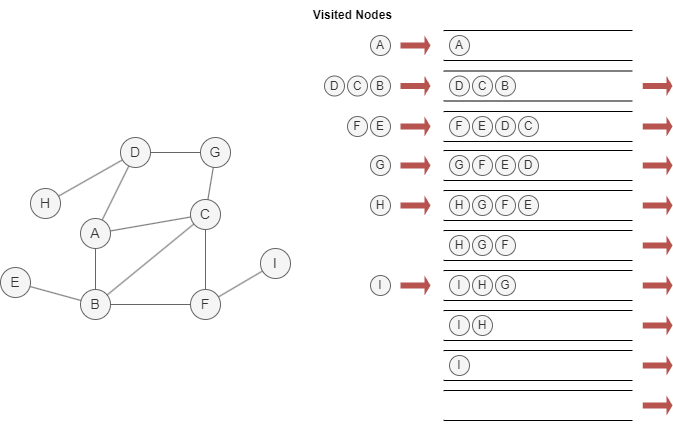
Considerations
- Only nodes within the same connected component as the start node will be traversed. Nodes in other connected components are excluded from the traversal results.
Example Graph
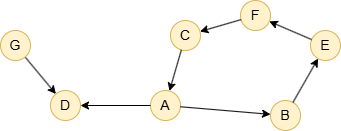
GQLINSERT (A:default {_id: "A"}), (B:default {_id: "B"}),
       (C:default {_id: "C"}), (D:default {_id: "D"}),
       (E:default {_id: "E"}), (F:default {_id: "F"}),
       (G:default {_id: "G"}),
       (A)-[:default]->(B), (A)-[:default]->(D),
       (B)-[:default]->(E), (C)-[:default]->(A),
       (E)-[:default]->(F), (F)-[:default]->(C),
       (G)-[:default]->(D)
Parameters
| Name | Type | Default | Description |
|---|---|---|---|
startNode | STRING | / | Required. Starting node _id. |
maxDepth | INT | -1 | Maximum depth to traverse (-1 = unlimited). |
direction | STRING | out | Edge direction: in, out, or both. |
maxResults | INT | -1 | Stop after visiting this many nodes (-1 = unlimited). This bounds the traversal itself, which is useful on very high-degree hubs where an outer LIMIT does not short-circuit the walk. |
Run Mode
Returns:
| Column | Type | Description |
|---|---|---|
nodeId | STRING | Node identifier (_id) |
depth | INT | Depth from start node |
parent | STRING | Parent node in BFS tree |
GQLCALL algo.bfs({
  startNode: "A"
}) YIELD nodeId, depth, parent
Result:
| nodeId | depth | parent |
|---|---|---|
| A | 0 | |
| D | 1 | A |
| B | 1 | A |
| E | 2 | B |
| F | 3 | E |
| C | 4 | F |
Stream Mode
Returns the same columns as run mode, streamed for memory efficiency.
GQLCALL algo.bfs.stream({
  startNode: "A",
  maxDepth: 2
}) YIELD nodeId, depth
RETURN nodeId, depth
Result:
| nodeId | depth |
|---|---|
| A | 0 |
| D | 1 |
| B | 1 |
| E | 2 |
Stats Mode
Returns:
| Column | Type | Description |
|---|---|---|
nodeCount | INT | Total number of nodes visited |
maxDepth | INT | Maximum depth reached from start node |
GQLCALL algo.bfs.stats({
  startNode: "A"
}) YIELD nodeCount, maxDepth
Result:
| nodeCount | maxDepth |
|---|---|
| 6 | 4 |