
p-Cohesion
Overview
The p-Cohesion algorithm computes a per-node cohesion value that measures how well each node is embedded within a densely connected neighborhood. The concept of p-cohesion was first proposed by S. Morris in a contagion model describing interactions within large populations:
- S. Morris, Contagion. The Review of Economic Studies, 67(1), 57–78 (2000)
Concepts
p-Cohesion
One natural measure of the cohesion of a group is the relative frequency of ties among its members compared to non-members. Let cohesion be a constant p ∈ (0,1). A p-Cohesion is a connected subgraph in which every node has, at least, a proportion p of its neighbors within the subgraph. In other words, each node has at most, a proportion (1 − p) of its neighbors outside the subgraph.
The p-Cohesion model offers two key advantages over other cohesive subgraph models:
- With a high
pvalue, p-Cohesion ensures both strong internal cohesiveness and sparse connections to outside nodes. - It considers the proportion of neighbors within the group rather than a fixed number (such as the
kvalue in k-Core), making it better suited for graphs with varying node degrees.
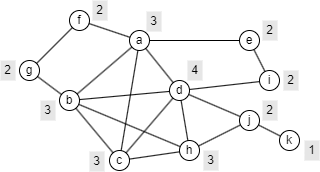
The example graph below illustrates this. Suppose p = 0.6. A grey label next to each node shows the minimum number of internal neighbors required for the node to remain in a p-Cohesion.
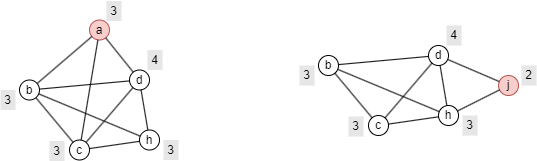
Below are the minimal p-Cohesion subgraphs, in terms of node count, that include node a and node j, respectively.
Cohesion Value
Finding the maximum p for which a node belongs to a p-cohesive subgraph is computationally hard, so this algorithm uses a tractable proxy based on k-Core decomposition:
- Compute each node's coreness: the largest
ksuch that the node belongs to a k-core (a subgraph where every member has at leastkneighbors inside). - Normalize by the node's total degree:
cohesion(v) = coreness(v) / degree(v).
The resulting value lies in [0, 1] and reflects the proportion of v's neighbors that remain with v in the deepest k-core containing it. A higher value indicates the node is embedded in a more tightly connected neighborhood.
NOTEThe cohesion value is a per-node ranking metric — it does not name the specific subgraph the node belongs to, and it differs from the literal maximum
pof the ratio-based p-Cohesion definition above (it's a lower bound on that quantity). For most analytical use cases the ranking it produces is what matters.
Considerations
- The algorithm treats all edges as undirected.
Example Graph
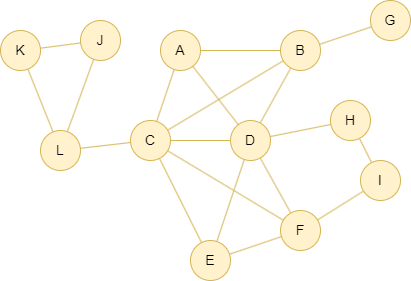
GQLINSERT (A:default {_id: "A"}), (B:default {_id: "B"}),
       (C:default {_id: "C"}), (D:default {_id: "D"}),
       (E:default {_id: "E"}), (F:default {_id: "F"}),
       (G:default {_id: "G"}), (H:default {_id: "H"}),
       (I:default {_id: "I"}), (J:default {_id: "J"}),
       (K:default {_id: "K"}), (L:default {_id: "L"}),
       (K)-[:default]->(J), (K)-[:default]->(L),
       (J)-[:default]->(L), (L)-[:default]->(C),
       (C)-[:default]->(A), (A)-[:default]->(B),
       (C)-[:default]->(B), (A)-[:default]->(D),
       (B)-[:default]->(G), (B)-[:default]->(D),
       (D)-[:default]->(C), (C)-[:default]->(E),
       (C)-[:default]->(F), (D)-[:default]->(E),
       (E)-[:default]->(F), (D)-[:default]->(F),
       (D)-[:default]->(H), (I)-[:default]->(H),
       (F)-[:default]->(I)
Parameters
| Name | Type | Default | Description |
|---|---|---|---|
p | FLOAT | / | Cohesion threshold (0 < p ≤ 1). When set, only nodes with cohesion ≥ p are returned. |
Run Mode
Returns:
| Column | Type | Description |
|---|---|---|
nodeId | STRING | Node identifier (_id) |
cohesion | FLOAT | Maximal p-cohesion value for this node |
GQLCALL algo.pcohesion({
  p: 0.7
}) YIELD nodeId, cohesion
Result:
| nodeId | cohesion |
|---|---|
| E | 1 |
| G | 1 |
| F | 0.75 |
| A | 1 |
| B | 0.75 |
| I | 1 |
| H | 1 |
| K | 1 |
| J | 1 |
Stream Mode
Returns the same columns as run mode, streamed for memory efficiency.
GQLCALL algo.pcohesion.stream({
  p: 0.8
}) YIELD nodeId, cohesion
RETURN nodeId, cohesion
Result:
| nodeId | cohesion |
|---|---|
| E | 1 |
| G | 1 |
| A | 1 |
| I | 1 |
| H | 1 |
| K | 1 |
| J | 1 |
Stats Mode
Returns:
| Column | Type | Description |
|---|---|---|
nodeCount | INT | Total number of nodes |
minCohesion | FLOAT | Minimum cohesion value |
maxCohesion | FLOAT | Maximum cohesion value |
avgCohesion | FLOAT | Average cohesion value |
GQLCALL algo.pcohesion.stats({
  p: 0.8
}) YIELD nodeCount, minCohesion, maxCohesion, avgCohesion
Write Mode
Computes results and writes them back to node properties. The write configuration is passed as a second argument map.
Write parameters:
| Name | Type | Description |
|---|---|---|
db.property | STRING or MAP | Node property to write results to. String: writes the cohesion column in results to a property. Map: explicit column-to-property mapping (e.g., {cohesion: 'p_cohesion'}). |
Writable columns:
| Column | Type | Description |
|---|---|---|
cohesion | FLOAT | Maximal p-cohesion value |
Returns:
| Column | Type | Description |
|---|---|---|
task_id | STRING | Task identifier for tracking via SHOW TASKS |
nodesWritten | INT | Number of nodes with properties written |
computeTimeMs | INT | Time spent computing the algorithm (milliseconds) |
writeTimeMs | INT | Time spent writing properties to storage (milliseconds) |
GQLCALL algo.pcohesion.write({}, {
  db: {
    property: "p_cohesion"
  }
}) YIELD task_id, nodesWritten, computeTimeMs, writeTimeMs