
Strongly Connected Components (SCC)
Overview
The SCC algorithm identifies the strongly connected components in a directed graph using Kosaraju's algorithm. A strongly connected component is a maximal subset of nodes where there is a directed path between every pair of nodes in both directions.
Concepts
Connected Component
A connected component is a maximal subset of nodes in a graph where all nodes in that subset are reachable from one another by following edges. A maximal subset means that no additional nodes can be added to the subset without breaking the connectivity requirement.
Strongly Connected Component
A strongly connected component (SCC) is a maximal subset of nodes in a directed graph where for any two nodes u and v, there exists a directed path from u to v and from v to u. All edges along these paths follow the original direction.
Unlike WCC which ignores edge direction, SCC respects it — two nodes are in the same SCC only if they can reach each other following directed edges.
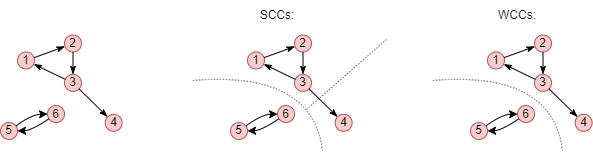
This example shows 3 strongly connected components and 2 weakly connected components. The number of SCCs is always ≥ the number of WCCs, since SCCs impose stricter connectivity conditions.
Considerations
- The algorithm respects edge direction.
- Each isolated node constitutes its own strongly connected component.
Example Graph
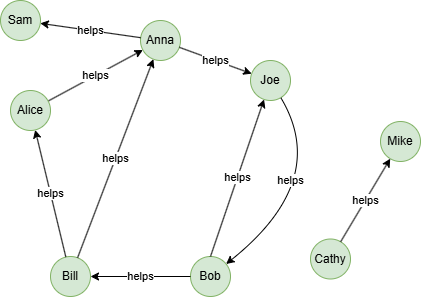
GQLINSERT (Mike:member {_id: "Mike"}), (Cathy:member {_id: "Cathy"}),
       (Anna:member {_id: "Anna"}), (Joe:member {_id: "Joe"}),
       (Sam:member {_id: "Sam"}), (Bob:member {_id: "Bob"}),
       (Bill:member {_id: "Bill"}), (Alice:member {_id: "Alice"}),
       (Cathy)-[:helps]->(Mike), (Anna)-[:helps]->(Sam),
       (Anna)-[:helps]->(Joe), (Joe)-[:helps]->(Bob),
       (Bob)-[:helps]->(Joe), (Bob)-[:helps]->(Bill),
       (Bill)-[:helps]->(Alice), (Bill)-[:helps]->(Anna),
       (Alice)-[:helps]->(Anna)
Run Mode
Returns:
| Column | Type | Description |
|---|---|---|
nodeId | STRING | Node identifier (_id) |
componentId | INT | Component identifier |
componentSize | INT | Number of nodes in component |
GQLCALL algo.scc() YIELD nodeId, componentId, componentSize
Result:
| nodeId | componentId | componentSize |
|---|---|---|
| Mike | 0 | 1 |
| Bill | 2 | 5 |
| Alice | 2 | 5 |
| Anna | 2 | 5 |
| Bob | 2 | 5 |
| Joe | 2 | 5 |
| Cathy | 3 | 1 |
| Sam | 1 | 1 |
Stream Mode
Returns the same columns as run mode, streamed for memory efficiency.
GQLCALL algo.scc.stream() YIELD nodeId, componentId, componentSize
RETURN componentId, COLLECT(nodeId) AS members, componentSize
GROUP BY componentId
Result:
| componentId | members | componentSize |
|---|---|---|
| 0 | ["Mike"] | 1 |
| 2 | ["Bill", "Alice", "Anna", "Bob", "Joe"] | 5 |
| 3 | ["Cathy"] | 1 |
| 1 | ["Sam"] | 1 |
Stats Mode
Returns:
| Column | Type | Description |
|---|---|---|
nodeCount | INT | Total number of nodes |
communityCount | INT | Number of strongly connected components |
largestCommunitySize | INT | Size of the largest component |
smallestCommunitySize | INT | Size of the smallest component |
GQLCALL algo.scc.stats() YIELD nodeCount, communityCount, largestCommunitySize, smallestCommunitySize
Result:
| nodeCount | communityCount | largestCommunitySize | smallestCommunitySize |
|---|---|---|---|
| 8 | 4 | 5 | 1 |
Write Mode
Computes results and writes them back to node properties. The write configuration is passed as a second argument map.
Write parameters:
| Name | Type | Description |
|---|---|---|
db.property | STRING or MAP | Node property to write results to. String: writes the componentId column in results to a property. Map: explicit column-to-property mapping (e.g., {componentId: 'scc_id'}). |
Writable columns:
| Column | Type | Description |
|---|---|---|
componentId | INT | Component identifier |
componentSize | INT | Component size |
Returns:
| Column | Type | Description |
|---|---|---|
task_id | STRING | Task identifier for tracking via SHOW TASKS |
nodesWritten | INT | Number of nodes with properties written |
computeTimeMs | INT | Time spent computing the algorithm (milliseconds) |
writeTimeMs | INT | Time spent writing properties to storage (milliseconds) |
GQLCALL algo.scc.write({}, {
  db: {
    property: "scc_id"
  }
}) YIELD task_id, nodesWritten, computeTimeMs, writeTimeMs