
FastRP
Overview
FastRP (Fast Random Projection) is a scalable and efficient algorithm for learning node representations in a graph. It computes node embeddings iteratively through two main steps: first, constructing a node similarity matrix; second, reducing dimension using random projection.
FastRP was proposed by H. Chen et al. in 2019:
- H. Chen, S.F. Sultan, Y. Tian, M. Chen, S. Skiena, Fast and Accurate Network Embeddings via Very Sparse Random Projection (2019)
Concepts
Very Sparse Random Projection
Random projection is a dimension reduction method that approximately preserves pairwise distances between data points when embedding them from a high-dimensional space to a lower-dimensional space. Its theoretical foundation is primarily based on the Johnson-Lindenstrauss Lemma.
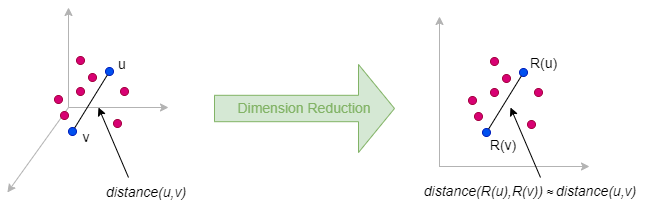
The idea behind random projection is very simple: to reduce a matrix Mn×m (n = m for graph data) to a lower-dimensional matrix Nn×d where d ≪ n, we multiply M by a random projection matrix Rm×d, i.e., N = M ⋅ R.
The matrix R is generated by independently sampling its entries from a random distribution. Specifically, FastRP uses very sparse random projection for dimension reduction, where each entry of R is sampled from the following distribution:
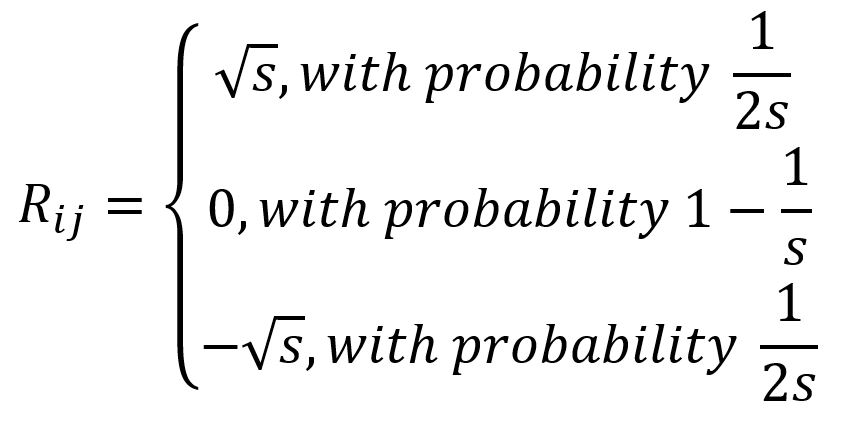
This implementation uses s = 3 (a standard choice from Achlioptas, 2003), giving 2/3 zero entries regardless of graph size.
FastRP Process
This implementation uses a simplified version of FastRP:
- Initialize: Assign each node a random embedding vector of size
dimensionsfrom the matrixR. - Iterations: In each iteration, update each node's embedding with the degree-normalized sum of its neighbors' embeddings. The weight for each neighbor is
(1/√deg(node)) × (1/√deg(neighbor)). L2-normalize all embeddings after each iteration.
The final embeddings capture higher-order neighborhood structure. More iterations incorporate information from farther neighbors.

Consider this graph with dimensions = 3, and iterations = 3.
Initialize: Each node gets a random vector from R:
| Node | Initial Embedding |
|---|---|
| A | [√3, 0, -√3] |
| B | [-√3, √3, 0] |
| C | [0, -√3, √3] |
| D | [√3, √3, 0] |
| E | [-√3, 0, √3] |
Iteration 1: Replace each node's embedding with the degree-normalized sum of its neighbors' embeddings.
- A (deg 2, neighbors
B,C):w(B) = 1/√2 × 1/√2 = 0.5,w(C) = 1/√2 × 1/√3 = 0.408- New
A = 0.5 × [-√3, √3, 0] + 0.408 × [0, -√3, √3] = [-0.866, 0.159, 0.707]
- B (deg 2, neighbors
A,C):w(A) = 1/√2 × 1/√2 = 0.5,w(C) = 1/√2 × 1/√3 = 0.408- New
B = 0.5 × [√3, 0, -√3] + 0.408 × [0, -√3, √3] = [0.866, -0.707, -0.159]
- C (deg 3, neighbors
A,B,D):w(A) = w(B) = w(D) = 1/√3 × 1/√2 = 0.408- New
C = 0.408 × ([√3, 0, -√3] + [-√3, √3, 0] + [√3, √3, 0]) = 0.408 × [√3, 2√3, -√3] = [0.707, 1.414, -0.707]
- D (deg 2, neighbors
C,E):w(C) = 1/√2 × 1/√3 = 0.408,w(E) = 1/√2 × 1/√1 = 0.707- New
D = 0.408 × [0, -√3, √3] + 0.707 × [-√3, 0, √3] = [-1.225, -0.707, 1.932]
- E (deg 1, neighbor
D):w(D) = 1/√1 × 1/√2 = 0.707- New
E = 0.707 × [√3, √3, 0] = [1.225, 1.225, 0]
L2-normalize each embedding:
| Node | After Aggregation | After L2 Normalization |
|---|---|---|
| A | [-0.866, 0.159, 0.707] | [-0.767, 0.141, 0.626] |
| B | [0.866, -0.707, -0.159] | [0.767, -0.626, -0.141] |
| C | [0.707, 1.414, -0.707] | [0.408, 0.817, -0.408] |
| D | [-1.225, -0.707, 1.932] | [-0.512, -0.295, 0.807] |
| E | [1.225, 1.225, 0] | [0.707, 0.707, 0] |
Iteration 2: Aggregate using iteration 1's normalized embeddings, then L2-normalize.
| Node | After Aggregation | After L2 Normalization |
|---|---|---|
| A | [0.550, 0.020, -0.237] | [0.918, 0.033, -0.396] |
| B | [-0.218, 0.404, 0.147] | [-0.452, 0.838, 0.305] |
| C | [-0.209, -0.318, 0.527] | [-0.322, -0.489, 0.811] |
| D | [0.666, 0.833, -0.166] | [0.617, 0.772, -0.154] |
| E | [-0.362, -0.209, 0.571] | [-0.511, -0.295, 0.807] |
Iteration 3: Aggregate using iteration 2's normalized embeddings, then L2-normalize.
| Node | After Aggregation | After L2 Normalization |
|---|---|---|
| A | [-0.357, 0.219, 0.484] | [-0.558, 0.342, 0.756] |
| B | [0.328, -0.183, 0.133] | [0.822, -0.459, 0.333] |
| C | [0.442, 0.670, -0.100] | [0.546, 0.828, -0.124] |
| D | [-0.492, -0.409, 0.902] | [-0.445, -0.370, 0.816] |
| E | [0.436, 0.546, -0.109] | [0.617, 0.772, -0.154] |
The final embeddings after 3 iterations capture higher-order neighborhood structure. For example, D and E (connected by a direct edge at the graph's periphery) have similar embeddings, while C (the hub connecting the triangle to the tail) has a distinct representation.
Considerations
- The FastRP algorithm treats all edges as undirected, ignoring their original direction.
Example Graph

GQLINSERT (A:default {_id: "A"}), (B:default {_id: "B"}),
       (C:default {_id: "C"}), (D:default {_id: "D"}),
       (E:default {_id: "E"}), (F:default {_id: "F"}),
       (G:default {_id: "G"}), (H:default {_id: "H"}),
       (I:default {_id: "I"}), (J:default {_id: "J"}),
       (A)-[:default]->(B), (A)-[:default]->(C),
       (C)-[:default]->(D), (D)-[:default]->(F),
       (E)-[:default]->(C), (E)-[:default]->(F),
       (F)-[:default]->(G), (G)-[:default]->(J),
       (H)-[:default]->(G), (H)-[:default]->(I)
Parameters
| Name | Type | Default | Description |
|---|---|---|---|
dimensions | INT | 128 | Embedding dimensionality. |
iterations | INT | 3 | Number of neighborhood aggregation iterations. |
Run Mode
Returns:
| Column | Type | Description |
|---|---|---|
nodeId | STRING | Node identifier (_id) |
embedding | LIST | Embedding vector as list of floats |
GQLCALL algo.fastrp({
  dimensions: 4,
  iterations: 3
}) YIELD nodeId, embedding
Result:
| nodeId | embedding |
|---|---|
| E | [-0.12305584238216578, -0.9849289931977, 0, 0.1215406846047056] |
| D | [-0.12305584238216578, -0.9849289931977, 0, 0.1215406846047056] |
| G | [0.19944689569581864, -0.6307138719181029, 0, 0.7499472965264802] |
| F | [0.33127632268542906, 0.8402566887979876, 0.4220239661881277, -0.07823341307333669] |
| A | [0.6233740178591791, -0.7819238031023892, 0, 0] |
| C | [0.37617303576428474, 0.40282571625744723, 0.8344011562105825, 0] |
| B | [0.18257418583505539, -0.3651483716701107, 0.9128709291752769, 0] |
| I | [0.16562448094810187, -0.22624724846371902, 0, 0.9598857816809603] |
| H | [0.039463326335005856, 0.6482021517653542, -0.5176220095931053, -0.5570853359281113] |
| J | [0.0978369619009961, 0.9523606161276394, -0.14938828920367186, -0.24722525110466798] |
Stream Mode
Returns the same columns as run mode, streamed for memory efficiency.
GQLCALL algo.fastrp.stream({
  dimensions: 4,
  iterations: 5
}) YIELD nodeId, embedding
RETURN nodeId, embedding
Result:
| nodeId | embedding |
|---|---|
| E | [0.05238941834261638, -0.976612633080473, 0, 0.2085260505388901] |
| D | [0.05238941834261638, -0.976612633080473, 0, 0.2085260505388901] |
| G | [0.14336228340880974, -0.6690631576935938, 0, 0.7292473837545729] |
| F | [0.3386046522415813, 0.802008181222618, 0.4722741460937271, -0.138155338889913] |
| A | [0.46037110185570496, -0.8871117229991454, 0, 0.03303391429503269] |
| C | [0.36661402390927234, 0.4375674709423969, 0.8205196705825633, -0.02960297338457617] |
| B | [0.2744041947368475, -0.09100420525735527, 0.9572985806613835, 0] |
| I | [0.18248026388033173, -0.3837038891535745, 0, 0.9052470815984914] |
| H | [0.0842161106069158, 0.7741056956969005, -0.3896263793987979, -0.49179193067845817] |
| J | [0.1539592446239621, 0.9207471581791898, -0.13197903833051786, -0.33332079914268237] |
Stats Mode
Returns:
| Column | Type | Description |
|---|---|---|
nodeCount | INT | Total number of nodes processed |
dimensions | INT | Embedding dimensionality |
GQLCALL algo.fastrp.stats({
  dimensions: 4
}) YIELD nodeCount, dimensions
Result:
| nodeCount | dimensions |
|---|---|
| 10 | 4 |
Write Mode
Computes results and writes them back to node properties. The write configuration is passed as a second argument map.
Write parameters:
| Name | Type | Description |
|---|---|---|
db.property | STRING or MAP | Node property to write results to. |
Writable columns:
| Column | Type | Description |
|---|---|---|
embedding | LIST | Embedding vector |
Returns:
| Column | Type | Description |
|---|---|---|
task_id | STRING | Task identifier for tracking via SHOW TASKS |
nodesWritten | INT | Number of nodes with properties written |
computeTimeMs | INT | Time spent computing the algorithm (milliseconds) |
writeTimeMs | INT | Time spent writing properties to storage (milliseconds) |
GQLCALL algo.fastrp.write({dimensions: 4}, {
  db: {
    property: "embedding"
  }
}) YIELD task_id, nodesWritten, computeTimeMs, writeTimeMs