
K-Hop Fast
Overview
The K-Hop Fast algorithm counts the number of nodes reachable within a specified hop range from a given start node. It uses a bitmap-based BFS with direction-optimized traversal, designed for high performance on large graphs.
Concepts
K-Hop Neighbors
The K-hop neighbors of a node are the nodes located at a shortest distance of K from that node. The shortest distance is the number of edges in the shortest path. In graph theory, a hop is when a node travels to another node via an edge.
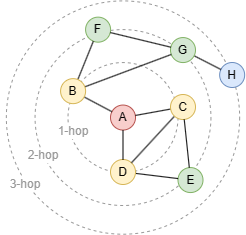
In this graph, nodes {B, C, D} are the 1-hop neighbors of node A, {E, F, G} are the 2-hop neighbors, and {H} is the 3-hop neighbor.
Key properties of K-hop neighbors:
Kis determined solely by the shortest distance and is unique. For example, there may be many paths between two nodes, butKis always the shortest. A node will only appear at one hop level.- K-hop results are deduplicated. Even if multiple shortest paths exist to the same node, it appears only once.
Considerations
- This algorithm requires the compute engine topology. Run
ALTER GRAPH <graphName> SET COMPUTE ENABLEDbefore using it.
Example Graph
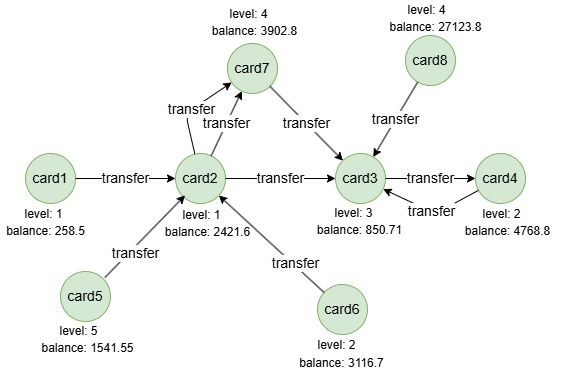
GQLINSERT (card1:card {_id: "card1"}), (card2:card {_id: "card2"}),
       (card3:card {_id: "card3"}), (card4:card {_id: "card4"}),
       (card5:card {_id: "card5"}), (card6:card {_id: "card6"}),
       (card7:card {_id: "card7"}), (card8:card {_id: "card8"}),
       (card1)-[:transfer]->(card2), (card2)-[:transfer]->(card3),
       (card2)-[:transfer]->(card7), (card2)-[:transfer]->(card7),
       (card3)-[:transfer]->(card4), (card4)-[:transfer]->(card3),
       (card5)-[:transfer]->(card2), (card6)-[:transfer]->(card2),
       (card7)-[:transfer]->(card3), (card8)-[:transfer]->(card3)
Parameters
| Name | Type | Default | Description |
|---|---|---|---|
startNode | STRING | / | Required. Starting node _id. |
maxHops | INT | 3 | Maximum number of hops. |
minHops | INT | 1 | Minimum number of hops to start counting. |
direction | STRING | out | Edge direction: in, out, or both. |
Run Mode
Returns:
| Column | Type | Description |
|---|---|---|
count | INT | Total number of K-hop neighbors in the hop range |
hops | LIST | Per-hop counts as a list of integers |
GQLCALL algo.khop_fast({
  startNode: "card1",
  maxHops: 3,
  direction: "out"
}) YIELD count, hops
Result:
| count | hops |
|---|---|
| 1 | 4 |
Stats Mode
Returns:
| Column | Type | Description |
|---|---|---|
count | INT | Total number of K-hop neighbors |
nodeCount | INT | Total nodes in graph |
GQLCALL algo.khop_fast.stats({
  startNode: "card1",
  maxHops: 3,
  direction: "out"
}) YIELD count, nodeCount
Result:
| count | nodeCount |
|---|---|
| 3 | 8 |