
Random Walk
Overview
A random walk begins at a specific node in a graph and moves by randomly selecting one of its neighboring nodes at each step. This process is often repeated for a set number of steps. Introduced by British mathematician and biostatistician Karl Pearson in 1905, the concept has since become a cornerstone in studying a wide range of systems, both inside and beyond graph theory.
- K. Pearson, The Problem of the Random Walk (1905)
Concepts
Random Walk
A random walk is a mathematical model employed to simulate a sequence of steps taken in a stochastic or unpredictable manner—much like the erratic path of a drunken person.
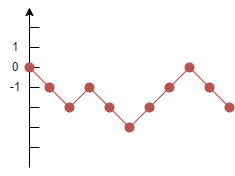
The simplest form of a random walk occurs in one-dimensional space: a node starts at the origin of a number line and moves either one unit up or down at each step, with equal probability. An example of a 10-step random walk is shown below:
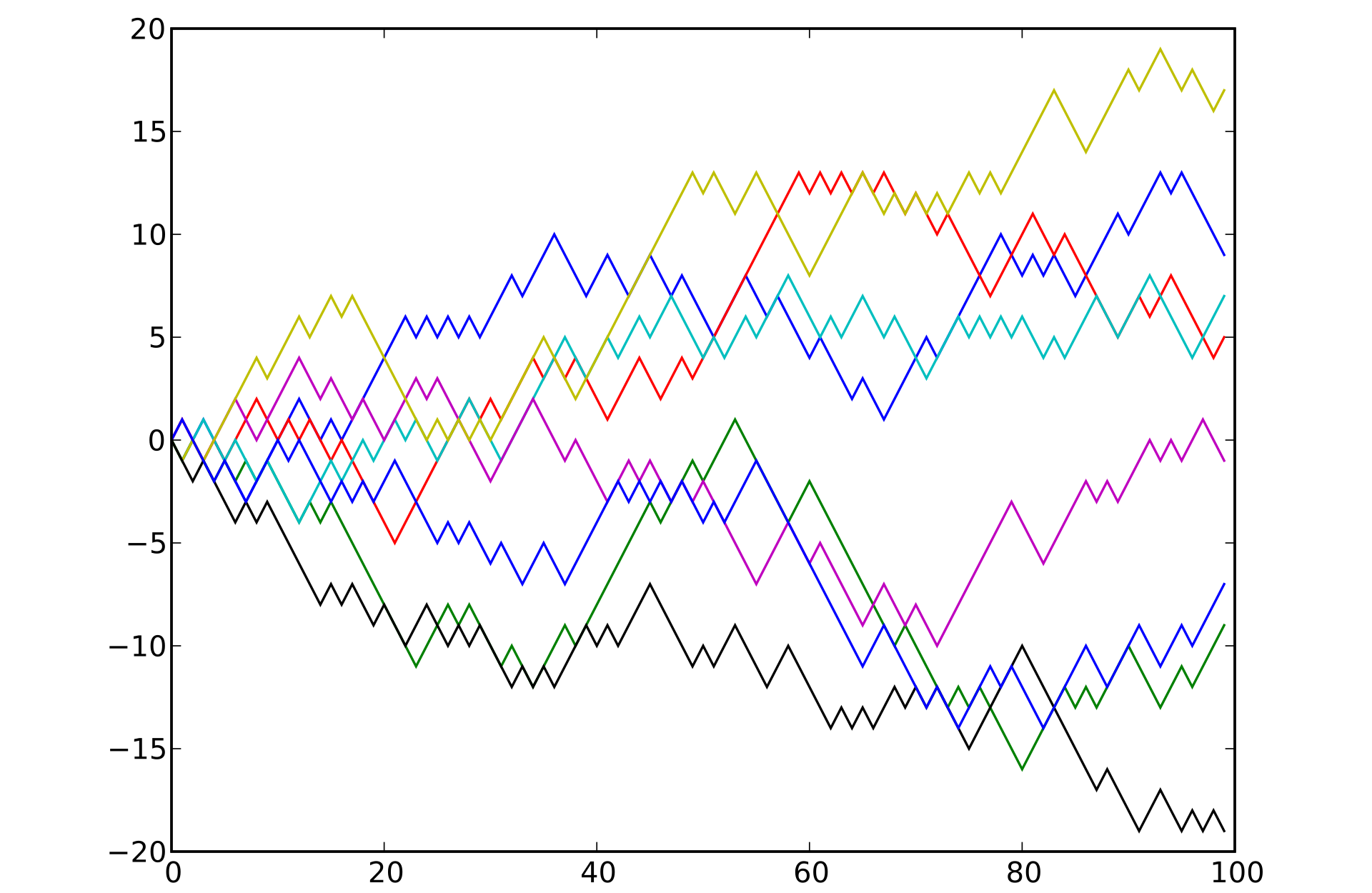
Here is an example of performing multiple random walks, each consisting of 100 steps:
Random Walk in Graph
In a graph, a random walk is a process that forms a path by starting at a node and sequentially moving to neighboring nodes. This process is controlled by the walk depth, which determines how many nodes will be visited.
Ultipa's Random Walk algorithm implements the classical uniform random walk: at each step, the next node is picked uniformly at random from the current node's outgoing neighbors.
Considerations
- The algorithm follows outgoing edges only.
- Self-loops can also be traversed during a random walk.
- A walk terminates early if it reaches a node with no outgoing neighbors, so the resulting
nodeSequencemay be shorter thanwalkLength.
Example Graph
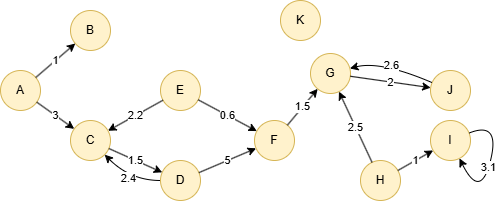
GQLINSERT (A:default {_id: "A"}), (B:default {_id: "B"}),
       (C:default {_id: "C"}), (D:default {_id: "D"}),
       (E:default {_id: "E"}), (F:default {_id: "F"}),
       (G:default {_id: "G"}), (H:default {_id: "H"}),
       (I:default {_id: "I"}), (J:default {_id: "J"}),
       (K:default {_id: "K"}),
       (A)-[:default]->(B), (A)-[:default]->(C),
       (C)-[:default]->(D), (D)-[:default]->(C),
       (D)-[:default]->(F), (E)-[:default]->(C),
       (E)-[:default]->(F), (F)-[:default]->(G),
       (G)-[:default]->(J), (H)-[:default]->(G),
       (H)-[:default]->(I), (I)-[:default]->(I),
       (J)-[:default]->(G)
Parameters
| Name | Type | Default | Description |
|---|---|---|---|
startNode | STRING | / | Required. Starting node _id. |
walkLength | INT | 80 | Number of nodes in each walk (including the start node). |
walksPerNode | INT | 10 | Number of walks to generate. |
Run Mode
Returns:
| Column | Type | Description |
|---|---|---|
walkId | INT | Walk sequence number |
nodeSequence | LIST | Ordered list of node _ids visited |
GQLCALL algo.randomwalk({
  startNode: "A",
  walkLength: 6,
  walksPerNode: 2
}) YIELD walkId, nodeSequence
Result:
| walkId | nodeSequence |
|---|---|
| 0 | ["A", "C", "D", "C", "D", "C"] |
| 1 | ["A", "C", "D", "F", "G", "J"] |
Stream Mode
Returns the same columns as run mode, streamed for memory efficiency.
GQLCALL algo.randomwalk.stream({
  startNode: "A",
  walkLength: 6,
  walksPerNode: 2
}) YIELD walkId, nodeSequence
RETURN walkId, nodeSequence
Result:
| walkId | nodeSequence |
|---|---|
| 0 | ["A", "C", "D", "C", "D", "C"] |
| 1 | ["A", "C", "D", "F", "G", "J"] |
Stats Mode
Returns:
| Column | Type | Description |
|---|---|---|
walkCount | INT | Total number of walks generated |
avgWalkLength | FLOAT | Average walk length across all walks |
GQLCALL algo.randomwalk.stats({
  startNode: "A",
  walkLength: 6,
  walksPerNode: 2
}) YIELD walkCount, avgWalkLength
Result:
| walkCount | avgWalkLength |
|---|---|
| 2 | 6 |