
Degree Centrality
Overview
The Degree Centrality finds important nodes in the network, it measures the number of incoming and/or outgoing edges incident to the node, or the sum of weights of those edges. Degree is the simplest and most efficient graph algorithm since it only considers the 1-hop neighborhood of nodes. Degree plays a vital role in scientific computing, feature extraction, supernode recognition and other fields.
Concepts
In-Degree and Out-Degree
The number of incoming edges a node has is called its in-degree; accordingly, the number of outgoing edges is called out-degree. If ignores edge direction, it is degree.
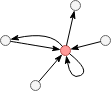
In this graph, the red node has in-degree of 4 and out-degree of 3, and its degree is 7. A directed self-loop is regarded as both an incoming and an outgoing edge.
Weighted Degree
In many applications, each edge of a graph has an associated numeric value, called weight. In weighted graph, weighted degree of a node is the sum of weights of all its neighbor edges. Unweighted degree is equivalent to when all edge weights are 1.
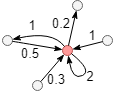
In this weighted graph, the red node has weighted in-degree of 0.5 + 0.3 + 2 + 1 = 3.8 and weighted out-degree of 1 + 0.2 + 2 = 3.2, and its weighted degree is 3.2 + 3.8 = 7.
Considerations
- The degree of an isolated node depends only on its self-loop. If it has no self-loop, degree is 0.
- Every self-loop is counted as two edges attaching to its node. Directed self-loop is viewed as an incoming edge and an outgoing edge.
Example Graph
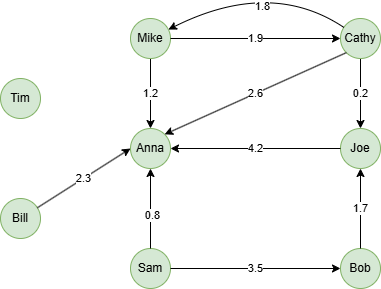
GQLINSERT (Mike:user {_id: "Mike"}), (Cathy:user {_id: "Cathy"}),
       (Anna:user {_id: "Anna"}), (Joe:user {_id: "Joe"}),
       (Sam:user {_id: "Sam"}), (Bob:user {_id: "Bob"}),
       (Bill:user {_id: "Bill"}), (Tim:user {_id: "Tim"}),
       (Mike)-[:follow {score: 1.9}]->(Cathy), (Cathy)-[:follow {score: 1.8}]->(Mike),
       (Mike)-[:follow {score: 1.2}]->(Anna), (Cathy)-[:follow {score: 2.6}]->(Anna),
       (Cathy)-[:follow {score: 0.2}]->(Joe), (Joe)-[:follow {score: 4.2}]->(Anna),
       (Bob)-[:follow {score: 1.7}]->(Joe), (Sam)-[:follow {score: 3.5}]->(Bob),
       (Sam)-[:follow {score: 0.8}]->(Anna), (Bill)-[:follow {score: 2.3}]->(Anna)
Parameters
| Name | Type | Default | Description |
|---|---|---|---|
ids | LIST | / | _ids of nodes to compute (empty = all nodes). |
direction | STRING | both | Edge direction: in, out, or both. |
normalized | BOOL | false | Whether to normalize scores. When true, uses scoreBase to determine the denominator. |
scoreBase | STRING | max | Normalization base, only effective when normalized is true. max divides by the max degree; count divides by node count - 1. |
weight | STRING or LIST | / | Edge property name(s) for weighted degree. |
limit | INT | -1 | Limits the number of results returned (-1 = all). |
order | STRING | / | Sorts the results by score: asc or desc. |
Run Mode
Returns:
| Column | Type | Description |
|---|---|---|
nodeId | STRING | Node identifier (_id) |
degree | FLOAT | Degree count (or weighted sum) |
score | FLOAT | Degree score (normalized if normalized is true) |
inDegree | INT | In-degree count |
outDegree | INT | Out-degree count |
weightScores | MAP | Per-property weighted degree breakdown (only present when weight is used) |
Normalized degree for all nodes:
GQLCALL algo.degree({
  normalized: true,
  order: "desc"
}) YIELD nodeId, degree, score, inDegree, outDegree
Result:
| nodeId | degree | score | inDegree | outDegree |
|---|---|---|---|---|
| Anna | 5 | 1 | 5 | 0 |
| Cathy | 4 | 0.8 | 1 | 3 |
| Joe | 3 | 0.6 | 2 | 1 |
| Mike | 3 | 0.6 | 1 | 2 |
| Bob | 2 | 0.4 | 1 | 1 |
| Sam | 2 | 0.4 | 0 | 2 |
| Bill | 1 | 0.2 | 0 | 1 |
| Tim | 0 | 0 | 0 | 0 |
Out-degree top 3:
GQLCALL algo.degree({
  direction: "out",
  order: "desc",
  limit: 3
}) YIELD nodeId, degree
Result:
| nodeId | degree |
|---|---|
| Cathy | 3 |
| Mike | 2 |
| Sam | 2 |
Weighted degree:
GQLCALL algo.degree({
  weight: "score",
  order: "desc"
}) YIELD nodeId, degree, weightScores
Result:
| nodeId | degree | weightScores |
|---|---|---|
| Anna | 11.1 | {score: 11.1} |
| Cathy | 6.5 | {score: 6.5} |
| Joe | 6.1 | {score: 6.1} |
| Bob | 5.2 | {score: 5.2} |
| Mike | 4.9 | {score: 4.9} |
| Sam | 4.3 | {score: 4.3} |
| Bill | 2.3 | {score: 2.3} |
| Tim | 0 | {score: 0} |
Stream Mode
Returns the same columns as run mode, streamed for memory efficiency.
Find neighbors of the node with the highest out-degree:
GQLCALL algo.degree.stream({
  direction: "out",
  order: "desc",
  limit: 1
}) YIELD nodeId, degree
MATCH (src WHERE src._id = nodeId)-(neigh)
RETURN DISTINCT neigh._id
Result:
| neigh._id |
|---|
| Anna |
| Joe |
| Mike |
Stats Mode
Returns:
| Column | Type | Description |
|---|---|---|
nodeCount | INT | Total number of nodes |
minScore | FLOAT | Minimum degree score |
maxScore | FLOAT | Maximum degree score |
avgScore | FLOAT | Average degree score |
GQLCALL algo.degree.stats() YIELD nodeCount, minScore, maxScore, avgScore
Result:
| nodeCount | minScore | maxScore | avgScore |
|---|---|---|---|
| 8 | 0 | 5 | 2.5 |
Write Mode
Computes results and writes them back to node properties. The write configuration is passed as a second argument map.
Write parameters:
| Name | Type | Description |
|---|---|---|
db.property | STRING or MAP | Node property to write results to. String: writes the score column to a property. Map: explicit column-to-property mapping (e.g., {score: 'deg_score', inDegree: 'in_deg'}). |
Writable columns:
| Column | Type | Description |
|---|---|---|
degree | FLOAT | Degree count |
score | FLOAT | Degree score |
inDegree | INT | In-degree count |
outDegree | INT | Out-degree count |
Returns:
| Column | Type | Description |
|---|---|---|
task_id | STRING | Task identifier for tracking via SHOW TASKS |
nodesWritten | INT | Number of nodes with properties written |
computeTimeMs | INT | Time spent computing the algorithm (milliseconds) |
writeTimeMs | INT | Time spent writing properties to storage (milliseconds) |
GQLCALL algo.degree.write({}, {
  db: {
    property: "deg_score"
  }
}) YIELD task_id, nodesWritten, computeTimeMs, writeTimeMs