
K-1 Coloring
Overview
The K-1 Coloring algorithm assigns colors to nodes so that no two adjacent nodes share the same color, while minimizing the total number of colors used.
- U.V. Çatalyürek, J. Feo, A.H. Gebremedhin, M. Halappanavar, A. Pothen, Graph Coloring Algorithms for Multi-core and Massively Multithreaded Architectures (2018)
Concepts
Distance-1 Graph Coloring
Distance-1 graph coloring, also known as K-1 graph coloring, is a concept in graph theory where the goal is to assign colors (represented by integers 0, 1, 2, ...) to the nodes of a graph such that no two nodes at distance 1 from each other (i.e., adjacent nodes) share the same color. The objective is also to minimize the number of colors used.
One of the most famous applications of graph coloring is geographical map coloring, where regions on a map are represented as nodes, and edges connect adjacent regions (those sharing a border). The task is to color the regions so that no two adjacent regions have the same color.
This concept has many practical applications beyond maps. For example, in school scheduling, each class is represented as a node, and edges indicate conflicts (such as two classes needing the same room). By coloring the graph, each class is assigned a "color" that represents a different time slot, ensuring no two conflicting classes are scheduled simultaneously.
Greedy Coloring Algorithm
The graph coloring problem is NP-hard to solve optimally, but near-optimal solutions can be obtained using a greedy algorithm.
At the beginning of the greedy algorithm, each node v in the graph is initialized as uncolored. The algorithm processes each node v as below:
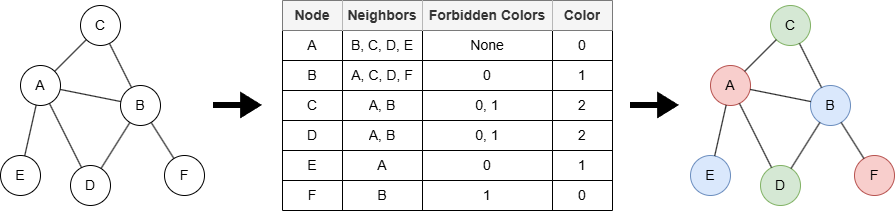
- For every adjacent node
wofv, mark the color ofwas forbidden forv. - Assign the smallest available color to
vthat is different from all its forbidden colors.
The algorithm uses an iterative parallel approach: in each iteration, colors are tentatively assigned in parallel, then conflicts (adjacent nodes with the same color) are detected and re-colored in the next iteration.
Considerations
- The algorithm treats all edges as undirected.
- The greedy approach does not guarantee the minimum number of colors — it produces a near-optimal solution.
- Results may vary between runs due to parallel execution order.
Example Graph
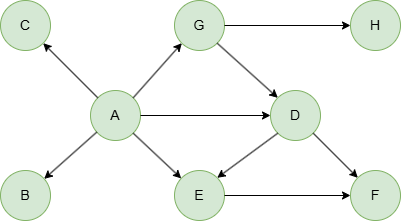
GQLINSERT (A:default {_id: "A"}), (B:default {_id: "B"}),
       (C:default {_id: "C"}), (D:default {_id: "D"}),
       (E:default {_id: "E"}), (F:default {_id: "F"}),
       (G:default {_id: "G"}), (H:default {_id: "H"}),
       (A)-[:default]->(B), (A)-[:default]->(C),
       (A)-[:default]->(D), (A)-[:default]->(E),
       (A)-[:default]->(G), (D)-[:default]->(E),
       (D)-[:default]->(F), (E)-[:default]->(F),
       (G)-[:default]->(D), (G)-[:default]->(H)
Parameters
| Name | Type | Default | Description |
|---|---|---|---|
maxIterations | INT | 10 | Maximum number of conflict resolution iterations. |
minCommunitySize | INT | 0 | Minimum color group size to include in results (0 = include all). |
limit | INT | -1 | Limits the number of results returned (-1 = all). |
order | STRING | / | Sorts the results by color: asc or desc. |
Run Mode
Returns:
| Column | Type | Description |
|---|---|---|
nodeId | STRING | Node identifier (_id) |
color | INT | Assigned color |
colorCount | INT | Total number of colors used |
GQLCALL algo.k1coloring() YIELD nodeId, color, colorCount
Stream Mode
Returns the same columns as run mode, streamed for memory efficiency.
GQLCALL algo.k1coloring.stream() YIELD nodeId, color
RETURN color, COLLECT(nodeId) AS nodes, COUNT(nodeId) AS size
GROUP BY color
Stats Mode
Returns:
| Column | Type | Description |
|---|---|---|
nodeCount | INT | Total number of nodes |
colorCount | INT | Total number of colors used |
GQLCALL algo.k1coloring.stats() YIELD nodeCount, colorCount
Write Mode
Computes results and writes them back to node properties. The write configuration is passed as a second argument map.
Write parameters:
| Name | Type | Description |
|---|---|---|
db.property | STRING or MAP | Node property to write results to. String: writes the color column in results to a property. Map: explicit column-to-property mapping (e.g., {color: 'node_color'}). |
Writable columns:
| Column | Type | Description |
|---|---|---|
color | INT | Assigned color |
Returns:
| Column | Type | Description |
|---|---|---|
task_id | STRING | Task identifier for tracking via SHOW TASKS |
nodesWritten | INT | Number of nodes with properties written |
computeTimeMs | INT | Time spent computing the algorithm (milliseconds) |
writeTimeMs | INT | Time spent writing properties to storage (milliseconds) |
GQLCALL algo.k1coloring.write({}, {
  db: {
    property: "node_color"
  }
}) YIELD task_id, nodesWritten, computeTimeMs, writeTimeMs