
Preferential Attachment
Overview
Preferential attachment is a common phenomenon in complex networks, where nodes with more existing connections are more likely to attract new ones. When both nodes have a large number of connections, the probability of them forming a connection is significantly higher. This phenomenon was utilized by A. Barabási and R. Albert in their proposed BA model for generating random scale-free networks in 2002:
- R. Albert, A. Barabási, Statistical mechanics of complex networks (2001)
The Preferential Attachment algorithm measures the similarity between two nodes by multiplying the number of neighbors each node has. It is computed using the following formula:

where N(x) and N(y) are the sets of adjacent nodes to nodes x and y respectively.
Higher Preferential Attachment scores indicate a greater similarity between two nodes, while a score of 0 indicates no such similarity.
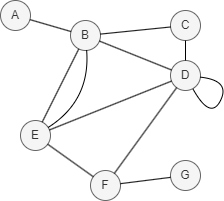
In this example, PA(D,E) = |N(D)| * |N(E)| = |{B, C, E, F}| * |{B, D, F}| = 4 * 3 = 12.
Considerations
- The Preferential Attachment algorithm treats all edges as undirected, ignoring their original direction.
Example Graph

GQLINSERT (A:default {_id: "A"}), (B:default {_id: "B"}),
       (C:default {_id: "C"}), (D:default {_id: "D"}),
       (E:default {_id: "E"}), (F:default {_id: "F"}),
       (G:default {_id: "G"}), (A)-[:default]->(B),
       (B)-[:default]->(E), (C)-[:default]->(B),
       (C)-[:default]->(D), (C)-[:default]->(F),
       (D)-[:default]->(B), (D)-[:default]->(E),
       (F)-[:default]->(D)
Parameters
| Name | Type | Default | Description |
|---|---|---|---|
node1 | STRING | / | Required. First node _id. |
node2 | STRING | / | Required. Second node _id. |
Run Mode
Returns:
| Column | Type | Description |
|---|---|---|
node1 | STRING | First node identifier (_id) |
node2 | STRING | Second node identifier (_id) |
score | FLOAT | Preferential attachment score (product of degrees) |
GQLCALL algo.preferentialattachment({
  node1: "C",
  node2: "E"
}) YIELD node1, node2, score
Result:
| node1 | node2 | score |
|---|---|---|
| C | E | 6 |
Stream Mode
Returns the same columns as run mode, streamed for memory efficiency.
GQLCALL algo.preferentialattachment.stream({
  node1: "C",
  node2: "E"
}) YIELD node1, node2, score
RETURN node1, node2, score
Result:
| node1 | node2 | score |
|---|---|---|
| C | E | 6 |
Stats Mode
Returns:
| Column | Type | Description |
|---|---|---|
score | FLOAT | Preferential attachment score |
GQLCALL algo.preferentialattachment.stats({
  node1: "C",
  node2: "E"
}) YIELD score
Result:
| score |
|---|
| 6 |