
TextRank
Overview
TextRank, derived from PageRank, is a graph-based ranking model for text processing. It can be used for various natural language processing tasks, including keyword extraction, keyphrase extraction, and text summarization.
- R. Mihalcea, P. Tarau, TextRank: Bringing Order Into Texts (2004)
Concepts
Text as a Graph
To apply the TextRank algorithm, the text must first be represented as a graph. The structure of the graph depends on the specific application:
- Nodes: Text units that best fit the task, such as words, collocations, or sentences, are added as nodes in the graph.
- Edges: Relationships between text units, such as semantic similarity, co-occurrence, or contextual overlap, are used to connect nodes with edges.
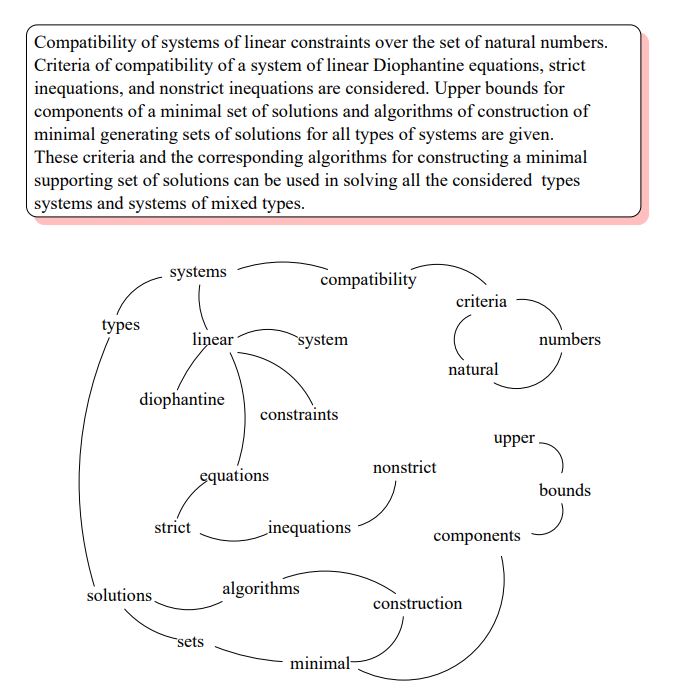
Sample graph build for keyphrase extraction (Source: Original paper)
TextRank Model
TextRank computes the ranks of all text units recursively using a "recommendation" mechanism, similar to the PageRank algorithm. It incorporates edge weights through a modified formula:

where,
Out(v)is the set of nodes that nodevpoints to;wvuis the edge weight between nodesvandu;dis the damping factor.
Compared to PageRank:
- Undirected: All edges are treated as undirected.
- Weighted: Edge weights influence rank propagation.
- Unnormalized: The base rank is
(1 - d)instead of(1 - d) / n, so scores do not sum to 1.
Considerations
- The rank of isolated text units will stay the same as the value of
(1 - d). - A self-loop acts as both a successor and a predecessor, meaning a node can pass some rank to itself. If a network has many self-loops, it will take more iterations to converge.
Example Graph
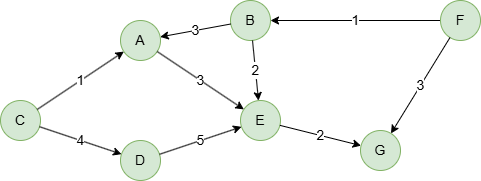
GQLINSERT (A:default {_id: "A"}), (B:default {_id: "B"}),
       (C:default {_id: "C"}), (D:default {_id: "D"}),
       (E:default {_id: "E"}), (F:default {_id: "F"}),
       (G:default {_id: "G"}),
       (A)-[:default {weight: 3}]->(E), (B)-[:default {weight: 3}]->(A),
       (B)-[:default {weight: 2}]->(E), (C)-[:default {weight: 1}]->(A),
       (C)-[:default {weight: 4}]->(D), (D)-[:default {weight: 5}]->(E),
       (E)-[:default {weight: 2}]->(G), (F)-[:default {weight: 1}]->(B),
       (F)-[:default {weight: 3}]->(G)
Parameters
| Name | Type | Default | Description |
|---|---|---|---|
weight | STRING or LIST | / | Edge property name(s) to use as weight (empty = unweighted). |
damping | FLOAT | 0.85 | Damping factor (0, 1). |
maxIterations | INT | 20 | Maximum number of iterations. |
tolerance | FLOAT | 0.0001 | Convergence tolerance. The algorithm terminates when score changes between iterations are less than this value. |
limit | INT | -1 | Limits the number of results returned (-1 = all). |
order | STRING | / | Sorts the results by score: asc or desc. |
Run Mode
Returns:
| Column | Type | Description |
|---|---|---|
nodeId | STRING | Node identifier (_id) |
score | FLOAT | TextRank score |
rank | INT | Rank position (1 = highest TextRank) |
TextRank for all nodes:
GQLCALL algo.textrank({
  weight: "weight",
  damping: 0.8,
  maxIterations: 50,
  order: "desc"
}) YIELD nodeId, score, rank
Result:
| nodeId | score | rank |
|---|---|---|
| E | 1.5865674783906416 | 1 |
| D | 1.2034026715882777 | 2 |
| A | 0.9951082779648479 | 3 |
| B | 0.8979722497449373 | 4 |
| G | 0.8473765204002381 | 5 |
| C | 0.741570712326908 | 6 |
| F | 0.7264444005265889 | 7 |
Stream Mode
Returns the same columns as run mode, streamed for memory efficiency.
GQLCALL algo.textrank.stream({
  order: "desc",
  limit: 3
}) YIELD nodeId, score
RETURN nodeId, score
Result:
| nodeId | score |
|---|---|
| E | 1.4296320035955716 |
| A | 1.0934842307056216 |
| B | 1.0934842307056216 |
Stats Mode
Returns:
| Column | Type | Description |
|---|---|---|
nodeCount | INT | Total number of nodes |
minScore | FLOAT | Minimum TextRank score |
maxScore | FLOAT | Maximum TextRank score |
avgScore | FLOAT | Average TextRank score |
GQLCALL algo.textrank.stats() YIELD nodeCount, minScore, maxScore, avgScore
Result:
| nodeCount | minScore | maxScore | avgScore |
|---|---|---|---|
| 7 | 0.7856051724452637 | 1.4296320035955716 | 0.9667775447847021 |
Write Mode
Computes results and writes them back to node properties. The write configuration is passed as a second argument map.
Write parameters:
| Name | Type | Description |
|---|---|---|
db.property | STRING or MAP | Node property to write results to. String: writes the score column in results to a property. Map: explicit column-to-property mapping (e.g., {score: 'tr_score', rank: 'tr_rank'}). |
Writable columns:
| Column | Type | Description |
|---|---|---|
score | FLOAT | TextRank score |
rank | INT | Rank position |
Returns:
| Column | Type | Description |
|---|---|---|
task_id | STRING | Task identifier for tracking via SHOW TASKS |
nodesWritten | INT | Number of nodes with properties written |
computeTimeMs | INT | Time spent computing the algorithm (milliseconds) |
writeTimeMs | INT | Time spent writing properties to storage (milliseconds) |
GQLCALL algo.textrank.write({damping: 0.85}, {
  db: {
    property: "tr_score"
  }
}) YIELD task_id, nodesWritten, computeTimeMs, writeTimeMs