
Path Functions
Example Graph

GQLINSERT (p1:Paper {_id:'P1', title:'Efficient Graph Search', score:6, author:'Alex'}),
       (p2:Paper {_id:'P2', title:'Optimizing Queries', score:9, author:'Alex'}),
       (p3:Paper {_id:'P3', title:'Path Patterns', score:7, author:'Zack'}),
       (p1)-[:Cites {weight:2}]->(p2),
       (p2)-[:Cites {weight:1}]->(p3)
path_length()
Returns the number of edges in a path. length() is a synonym.
| Syntax | path_length(<pathVar>) | ||
| Arguments | Name | Type | Description |
<pathVar> | PATH | Path variable reference | |
| Return Type | UINT | ||
GQLMATCH p = ()->{1,3}()
RETURN p, path_length(p) AS length
Result:
| p | length |
|---|---|
 | 2 |
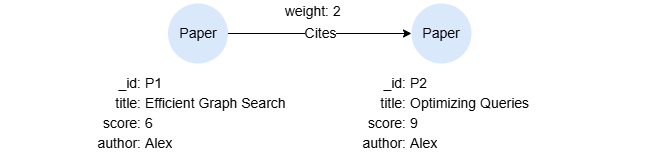 | 1 |
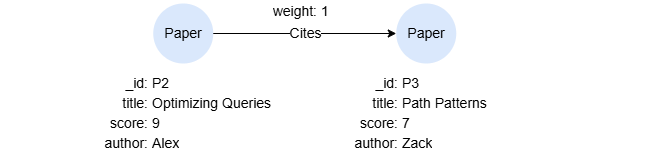 | 1 |
elements()
Returns a list containing the nodes and edges that make up a path, interleaved in order.
| Syntax | elements(<pathVar>) | ||
| Arguments | Name | Type | Description |
<pathVar> | PATH | Path variable reference | |
| Return Type | LIST | ||
GQLMATCH p = ()->()
LET items = elements(p)
FOR item IN items WITH ORDINALITY index
FILTER index %2 = 1
RETURN item
Result:
JSON[
  {"id": "P2", "labels": ["Paper"], "properties": {"title": "Optimizing Queries", "author": "Alex", "score": 9}},
  {"id": "P3", "labels": ["Paper"], "properties": {"title": "Path Patterns", "author": "Zack", "score": 7}},
  {"id": "P1", "labels": ["Paper"], "properties": {"title": "Efficient Graph Search", "author": "Alex", "score": 6}},
  {"id": "P2", "labels": ["Paper"], "properties": {"title": "Optimizing Queries", "author": "Alex", "score": 9}}
]
pnodes()
Returns the nodes of a path as a list. nodes() is a synonym.
| Syntax | pnodes(<pathVar>) | ||
| Arguments | Name | Type | Description |
<pathVar> | PATH | Path variable reference | |
| Return Type | LIST | ||
GQLMATCH p = ({_id: "P1"})->()
RETURN pnodes(p)
Result:
JSON[
  {
    "id": "P1",
    "labels": ["Paper"],
    "properties": {"score": 6, "author": "Alex", "title": "Efficient Graph Search"}
  },
  {
    "id": "P2",
    "labels": ["Paper"],
    "properties": {"title": "Optimizing Queries", "score": 9, "author": "Alex"}
  }
]
pedges()
Returns the edges of a path as a list. relationships() is a synonym.
| Syntax | pedges(<pathVar>) | ||
| Arguments | Name | Type | Description |
<pathVar> | PATH | Path variable reference | |
| Return Type | LIST | ||
GQLMATCH p = ({_id: "P1"})->()
RETURN pedges(p)
Result:
JSON[
  {
    "id": "e:1",
    "label": "Cites",
    "fromNodeId": "P1",
    "toNodeId": "P2",
    "properties": {"weight": 2}
  }
]
node_ids()
Collects the _id values of nodes in a path into a list. pnodeIds() is a synonym.
| Syntax | node_ids(<pathAlias>) | ||
| Arguments | Name | Type | Description |
<pathAlias> | PATH | Path alias reference | |
| Return Type | LIST | ||
GQLMATCH p = ({_id: "P1"})-[]->{1,2}()
RETURN node_ids(p)
Result:
| node_ids(p) |
|---|
| ["P1","P2"] |
| ["P1","P2","P3"] |
edge_ids()
Collects the _id values of edges in a path into a list. pedgeUuids() is a synonym.
| Syntax | edge_ids(<pathAlias>) | ||
| Arguments | Name | Type | Description |
<pathAlias> | PATH | Path alias reference | |
| Return Type | LIST | ||
GQLMATCH p = ({_id: "P1"})-[]->{1,2}()
RETURN edge_ids(p)
Result:
| edge_ids(p) |
|---|
| ["e:1"] |
| ["e:1","e:2"] |
ids()
Generic ID accessor that works on a path, a single node/edge, or a list of nodes/edges. Returns:
- For a path: a flat list of
_idvalues, with nodes and edges interleaved in path order. - For a single node or edge: the element's
_idas a string. - For a list of nodes/edges: a list of their
_idvalues (preserving null slots).
| Syntax | ids(<expr>) | ||
| Arguments | Name | Type | Description |
<expr> | PATH, NODE, EDGE, or LIST<NODE|EDGE> | The input expression | |
| Return Type | STRING or LIST<STRING> | ||
GQLMATCH p = ({_id: "P1"})-[]->()
RETURN ids(p)
Result:
| ids(p) |
|---|
| ["P1","e:1","P2"] |