
UltipaDocs
Products
Solutions
Resources
Company
Start Free Trial
UltipaDocs
Start Free Trial
  • Introduction
  • GQL vs Other Languages
    • Overview
    • Node and Edge Patterns
    • Path Patterns
    • Quantified Paths
    • Questioned Paths
    • Shortest Paths
    • Graph Patterns
    • Overview
    • Open Graph
    • Closed Graph
    • Constraints
    • Unique Identifiers
    • INSERT
    • INSERT OVERWRITE
    • SET
    • REMOVE
    • DELETE
    • Query Composition
    • Result Table and Visualization
    • MATCH
    • OPTIONAL MATCH
    • FILTER
    • LET
    • FOR
    • ORDER BY
    • LIMIT
    • SKIP
    • CALL
    • RETURN
    • Composite Query
    • NEXT
    • All Functions
    • Element Functions
    • Path Functions
    • Aggregate Functions
    • Mathematical Functions
    • Trigonometric Functions
    • String Functions
    • List Functions
    • Datetime Functions
    • Spatial Functions
    • Null Functions
    • Utility Functions
    • Type Conversion Functions
    • Table Functions
    • AI & Vector Functions
    • Database Functions
  • Operators
  • Predicates
    • CASE
    • LET Value Expression
    • Value Query Expression
    • List Comprehension
    • Index
    • Full-text Index
    • Vector Index
  • Transactions
  • Triggers
  • Query Management
  • Backup and Restore
    • Variables
    • Values and Types
    • Comments
    • Reserved Words
    • Syntactic Notation
  • GQL Conformance
  1. Docs
  2. /
  3. ISO GQL
  4. /
  5. Querying

LIMIT

Overview

The LIMIT statement restricts the maximum number of rows to be retained in the intermediate result table or output table. A non-negative integer must be specified in the LIMIT statement.

Syntax
<limit statement> ::= "LIMIT" <non-negative integer>

Example Graph

GQL
INSERT (p1:Paper {_id:'P1', title:'Efficient Graph Search', score:6, author:'Alex'}),
       (p2:Paper {_id:'P2', title:'Optimizing Queries', score:9, author:'Alex'}),
       (p3:Paper {_id:'P3', title:'Path Patterns', score:7, author:'Zack'}),
       (p1)-[:Cites]->(p2),
       (p2)-[:Cites]->(p3)

Limiting Rows Returned

GQL
MATCH (n:Paper)
RETURN n.title LIMIT 2

Result:

n.title
Efficient Graph Search
Optimizing Queries

Limiting Rows Passed Forward

GQL
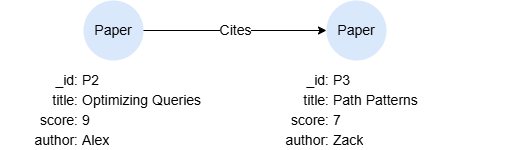
MATCH (n:Paper) LIMIT 1
MATCH p = (n)-()
RETURN p

Result: p
Limiting Ordered Rows

GQL
MATCH (n:Paper)
ORDER BY n.title DESC 
LIMIT 1
RETURN n.title

Result:

n.title
Path Patterns