UltipaDocs
Try Playground
  • Introduction
  • GQL vs Other Languages
    • Overview
    • Node and Edge Patterns
    • Path Patterns
    • Quantified Paths
    • Shortest Paths
    • Graph Patterns
    • Overview
    • Closed Graph
    • Open Graph
    • Graph Sharding and Storage
    • Constraints
    • Unique Identifiers
    • INSERT
    • INSERT OVERWRITE
    • UPSERT
    • SET
    • REMOVE
    • DELETE
    • Query Composition
    • Result Table and Visualization
    • MATCH
    • OPTIONAL MATCH
    • FILTER
    • LET
    • FOR
    • ORDER BY
    • LIMIT
    • SKIP
    • CALL
    • RETURN
    • Composite Query
    • NEXT
    • All Functions
    • Scalar Functions
    • Path Functions
    • Aggregate Functions
    • Mathematical Functions
    • Trigonometric Functions
    • String Functions
    • List Functions
    • Datetime Functions
    • Spatial Functions
    • Type Conversion Functions
    • Table Functions
    • AI & Vector Functions
    • Database Functions
  • Operators
  • Predicates
  • Expressions
    • Index
    • Full-text Index
    • Vector Index
  • Transactions
  • Triggers
  • Query Management
    • Variables
    • Values and Types
    • Comments
    • Reserved Words
    • Syntactic Notation
  • GQL Conformance
  1. Docs
  2. /
  3. ISO GQL
  4. /
  5. Querying

SKIP

Overview

The SKIP statement allows you to discard a specified number of records from the start of the intermediate result or output table. A non-negative integer must be specified in SKIP.

NOTE

OFFSET can be used as a synonym to SKIP.

Syntax
<skip statement> ::= "SKIP" <non-negative integer>

Example Graph

CREATE GRAPH myGraph { 
  NODE Paper ({title string, score uint32, author string}),
  EDGE Cites ()-[{}]->()
} PARTITION BY HASH(Crc32) SHARDS [1]

Skipping N Records

GQL
MATCH (n:Paper)
RETURN n.title SKIP 1

Result:

n.title
Efficient Graph Search
Path Patterns

Skipping N Ordered Records

GQL
MATCH (n:Paper)
ORDER BY n.score 
SKIP 1
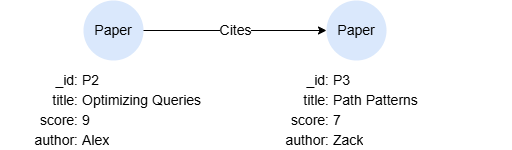
MATCH p = (n)->()
RETURN p

Result: p