
Composite Query
Overview
A composite query combines the result sets of multiple linear queries using the following query conjunctions:
| Query Conjunction | Description |
|---|---|
UNION | Returns distinct records from all result sets. |
UNION ALL | Returns all records from all result sets. |
EXCEPT | Returns distinct records in the 1st result set that do not appear in others. |
EXCEPT ALL | Returns all records in the 1st result set that do not appear in others. |
INTERSECT | Returns distinct records that appear in all result sets. |
INTERSECT ALL | Returns all records that appear in all result sets. |
OTHERWISE | Returns the first non-empty result set, in order of appearance. |
Details
UNION,EXCEPT, andINTERSECTperform deduplication on the final result set by default.- Different query conjunctions can be used within a composite query statement.
To combine the result sets of multiple linear queries, the RETURN statements in all linear queries include the same number of return items, in the same order and with the same names. Each return item with the same name must also have the same type.
Example Graph
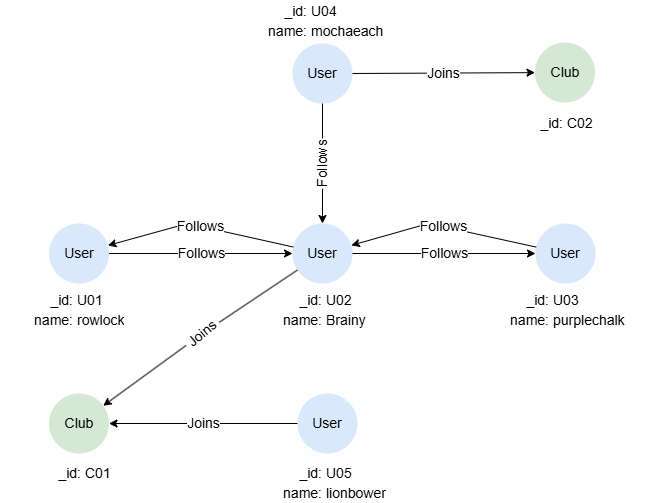
GQLINSERT (rowlock:User {_id:'U01', name:'rowlock'}),
       (brainy:User {_id:'U02', name:'Brainy'}),
       (purplechalk:User {_id:'U03', name:'purplechalk'}),
       (mochaeach:User {_id:'U04', name:'mochaeach'}),
       (lionbower:User {_id:'U05', name:'lionbower'}),
       (c01:Club {_id:'C01'}),
       (c02:Club {_id:'C02'}),
       (rowlock)-[:Follows]->(brainy),
       (brainy)-[:Follows]->(rowlock),
       (mochaeach)-[:Follows]->(brainy),
       (brainy)-[:Follows]->(purplechalk),
       (purplechalk)-[:Follows]->(brainy),
       (brainy)-[:Joins]->(c01),
       (lionbower)-[:Joins]->(c01),
       (mochaeach)-[:Joins]->(c02)
UNION
GQLMATCH (n:Club) RETURN n
UNION
MATCH (n) RETURN n
Result:
JSON[
  {"id": "C02", "labels": ["Club"], "properties": {}},
  {"id": "C01", "labels": ["Club"], "properties": {}},
  {"id": "U01", "labels": ["User"], "properties": {"name": "rowlock"}},
  {"id": "U02", "labels": ["User"], "properties": {"name": "Brainy"}},
  {"id": "U03", "labels": ["User"], "properties": {"name": "purplechalk"}},
  {"id": "U04", "labels": ["User"], "properties": {"name": "mochaeach"}},
  {"id": "U05", "labels": ["User"], "properties": {"name": "lionbower"}}
]
UNION ALL
GQLMATCH (n:Club) RETURN n
UNION ALL
MATCH (n) RETURN n
Result:
JSON[
  {"id": "C02", "labels": ["Club"], "properties": {}},
  {"id": "C01", "labels": ["Club"], "properties": {}},
  {"id": "U01", "labels": ["User"], "properties": {"name": "rowlock"}},
  {"id": "U02", "labels": ["User"], "properties": {"name": "Brainy"}},
  {"id": "U03", "labels": ["User"], "properties": {"name": "purplechalk"}},
  {"id": "U04", "labels": ["User"], "properties": {"name": "mochaeach"}},
  {"id": "U05", "labels": ["User"], "properties": {"name": "lionbower"}},
  {"id": "C02", "labels": ["Club"], "properties": {}},
  {"id": "C01", "labels": ["Club"], "properties": {}}
]
EXCEPT
GQLMATCH ({_id: "U02"})-(n) RETURN n
EXCEPT
MATCH ({_id: "U05"})-(n) RETURN n
Result:
JSON[
  {"id": "U04", "labels": ["User"], "properties": {"name": "mochaeach"}},
  {"id": "U03", "labels": ["User"], "properties": {"name": "purplechalk"}},
  {"id": "U01", "labels": ["User"], "properties": {"name": "rowlock"}}
]
EXCEPT ALL
GQLMATCH ({_id: "U02"})-(n) RETURN n
EXCEPT ALL
MATCH ({_id: "U05"})-(n) RETURN n
Result:
JSON[
  {"id": "U01", "labels": ["User"], "properties": {"name": "rowlock"}},
  {"id": "U03", "labels": ["User"], "properties": {"name": "purplechalk"}},
  {"id": "U04", "labels": ["User"], "properties": {"name": "mochaeach"}},
  {"id": "U03", "labels": ["User"], "properties": {"name": "purplechalk"}},
  {"id": "U01", "labels": ["User"], "properties": {"name": "rowlock"}}
]
INTERSECT
GQLMATCH ({_id: "U01"})-(u:User) RETURN u
INTERSECT
MATCH ({_id: "U03"})-(u:User) RETURN u
Result:
JSON[
  {"id": "U02", "labels": ["User"], "properties": {"name": "Brainy"}}
]
INTERSECT ALL
GQLMATCH ({_id: "U01"})-(u:User) RETURN u
INTERSECT ALL
MATCH ({_id: "U03"})-(u:User) RETURN u
Result:
JSON[
  {"id": "U02", "labels": ["User"], "properties": {"name": "Brainy"}},
  {"id": "U02", "labels": ["User"], "properties": {"name": "Brainy"}}
]
OTHERWISE
GQLMATCH ({_id: "U04"})<-[]-(u:User) RETURN u
OTHERWISE
MATCH ({_id: "U02"})<-[]-(u:User) RETURN u
Result:
JSON[
  {"id": "U01", "labels": ["User"], "properties": {"name": "rowlock"}},
  {"id": "U03", "labels": ["User"], "properties": {"name": "purplechalk"}},
  {"id": "U04", "labels": ["User"], "properties": {"name": "mochaeach"}}
]
In this example, the result set of the first linear query returns a null value due to the usage of OPTIONAL:
GQLOPTIONAL MATCH ({_id: "U04"})<-[]-(u:User) RETURN u
OTHERWISE
MATCH ({_id: "U02"})<-[]-(u:User) RETURN u
Result:
| u |
|---|
null |
Renaming Return Items
You may use the AS keyword to rename return items to ensure that the results of linear queries can be combined.
GQLMATCH ({_id: "C01"})<-(u) RETURN u.name, 1 AS Club
UNION
MATCH ({_id: "C02"})<-(u) RETURN u.name, 2 AS Club
Result:
| u.name | Club |
|---|---|
| Brainy | 1 |
| lionbower | 1 |
| mochaeach | 2 |
Using Different Query Conjunctions
GQLMATCH (n:Club) RETURN n._id
OTHERWISE
MATCH (n) RETURN n._id
UNION ALL
MATCH (n)-[]->(:Club) RETURN n._id
Result:
| n._id |
|---|
| C01 |
| C02 |
| U05 |
| U04 |
| U02 |