
SET
Overview
The SET statement allows you to set properties and labels on nodes and edges. These nodes or edges must first be retrieved using the MATCH statement.
Note:
- The unique identifier
_idis immutable. - The target of a
SETitem must be a node or edge variable bound by a graph pattern, i.e., a variable declared inMATCHorOPTIONAL MATCH, or in theON CREATE/ON MATCHclause ofMERGE. Variables of any other type are not valid targets.
Example Graph
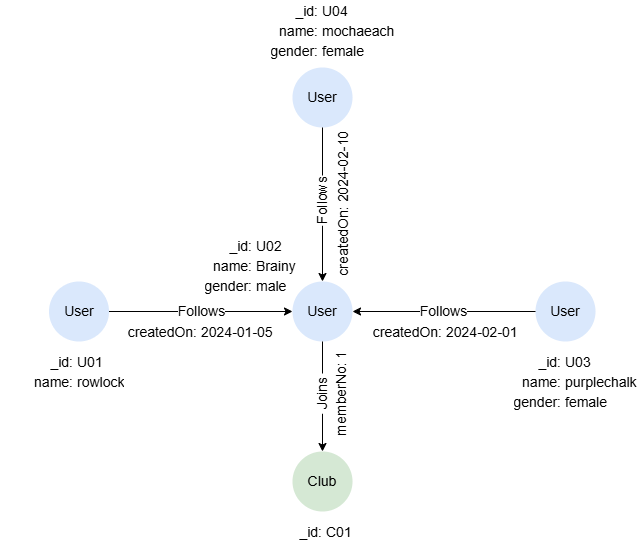
GQLINSERT (rowlock:User {_id: "U01", name: "rowlock"}),
       (brainy:User {_id: "U02", name: "Brainy", gender: "male"}),
       (purplechalk:User {_id: "U03", name: "purplechalk", gender: "female"}),
       (mochaeach:User {_id: "U04", name: "mochaeach", gender: "female"}),
       (c:Club {_id: "C01"}),
       (rowlock)-[:Follows {createdOn: date("2024-01-05")}]->(brainy),
       (purplechalk)-[:Follows {createdOn: date("2024-02-01")}]->(brainy),
       (mochaeach)-[:Follows {createdOn: date("2024-02-10")}]->(brainy),
       (brainy)-[:Joins {memberNo: 1}]->(c)
Setting Individual Properties
Update the value of each specified property:
GQLMATCH (n:User {name: 'rowlock'})-[e:Follows]->(:User {name: 'Brainy'})
SET n.gender = 'male', e.createdOn = date('2024-01-07')
RETURN n.gender, e.createdOn
Setting a property to null removes it in an open graph, or sets its value to null (the column remains) in a closed graph — the same behavior as REMOVE:
GQLMATCH (n:User {name: 'mochaeach'})
SET n.gender = null
Replacing All Properties
You can replace all properties (except _id) of a node or edge using a record. Any property included in the record will be updated, while all other properties will be set to null (closed graph) or removed (open graph).
GQLMATCH (n:User {name: 'purplechalk'})
SET n = {name: 'MasterSwift'}
RETURN n
Remove all property values by setting an empty record:
GQLMATCH (n:User {name: 'rowlock'})
SET n = {}
RETURN n
Merging Properties
While SET n = {record} replaces the entire property set, SET n += {record} merges the record into the existing properties: keys in the record are added or updated, and all other existing properties are preserved.
GQLMATCH (n:User {name: 'purplechalk'})
SET n += {gender: 'female', city: 'NYC'}
RETURN n
Nested Property Assignment
A chained SET target writes into a value nested inside a RECORD, LIST, or VECTOR — updating just that leaf without rewriting the entire root property. For example:
- a record field (
n.rec.field) - a nested record field (
n.rec.subRec.field) - a list element (
n.list[i]) - a record field within a list (
n.list[i].field) - a vector element (
n.vec[i], which must be numeric)
RECORD fields that do not exist yet are created automatically; LIST / VECTOR positions are not auto-created.
GQL-- RECORD: set one field
MATCH (n:User {_id: 'U01'}) SET n.profile.email = '[email protected]'

-- RECORD: set one field in a sub-record
MATCH (n:User {_id: 'U01'}) SET n.profile.address.city = 'Tokyo'

-- LIST<RECORD>: index then key; first index [0] → then key .tag (the position must already exist)
-- e.g., n.history = [{tag: 'old', note: 'first'}, {tag: 'foo'}] -> [{tag: 'pinned', note: 'first'}, {tag: 'foo'}]
MATCH (n:User {_id: 'U01'}) SET n.history[0].tag = 'pinned'

-- LIST<Type>: set an element by index (the position must already exist)
-- e.g., n.scores = [10, 20, 30]  ->  [10, 99, 30]
MATCH (n:User {_id: 'U01'}) SET n.scores[1] = 99

-- VECTOR: set a numeric element by index (the position must already exist)
-- e.g., n.embedding = [0.1, 0.2, 0.3]  ->  [0.95, 0.2, 0.3]
MATCH (n:User {_id: 'U01'}) SET n.embedding[0] = 0.95
Setting Labels
Add one label to a node:
GQLMATCH (n:User {name: 'rowlock'})
SET n:Player

-- 'IS <Label>' is an ISO-standard synonym for ':<Label>'
MATCH (n:User {name: 'rowlock'})
SET n IS Player
Add multiple labels to a node:
GQLMATCH (n:User {name: 'rowlock'})
SET n:Player, n:Employee
Update labels of FOLLOWS edges to Links (each edge has up to one label):
GQLMATCH ()-[e:Follows]->()
SET e:Links
NOTETo remove labels from nodes or edges, use the REMOVE statement.