
NEXT
Overview
The NEXT statement chains multiple linear or composite query statements, where the result of one query is carried forward to the next. This allows for advanced linear composition, enabling more complex queries.
Syntax<advanced linear query> ::= <query> <next statement> <query> ...

<next statement> ::= "NEXT" [ <yield clause> ]

<yield clause> ::= "YIELD" <yield item> [ { "," <yield item> }... ]

<yield item> ::= <column name> [ "AS" <binding variable> ]
Details
- The conclusion of each
<query>must contain aRETURNstatement, specifying the variables that can be referenced in the<query>immediately afterNEXT. - The
NEXTstatement supports theYIELDclause. See NEXT YIELD.
Example Graph
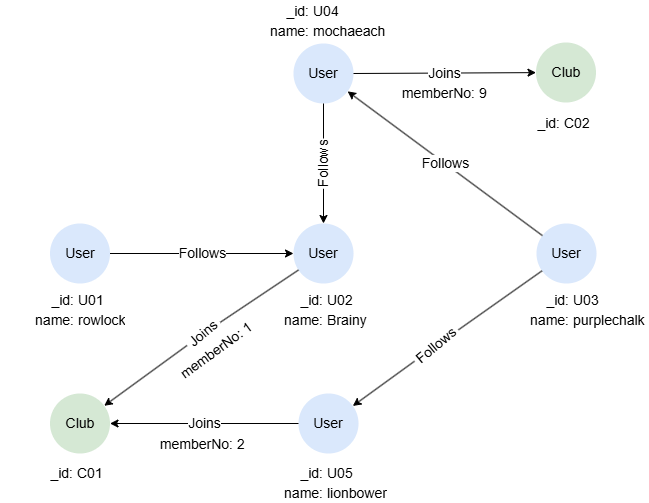
GQLINSERT (rowlock:User {_id: 'U01', name: 'rowlock'}),
       (brainy:User {_id: 'U02', name: 'Brainy'}),
       (purplechalk:User {_id: 'U03', name: 'purplechalk'}),
       (mochaeach:User {_id: 'U04', name: 'mochaeach'}),
       (lionbower:User {_id: 'U05', name: 'lionbower'}),
       (c01:Club {_id: 'C01'}),
       (c02:Club {_id: 'C02'}),
       (rowlock)-[:Follows]->(brainy),
       (mochaeach)-[:Follows]->(brainy),
       (purplechalk)-[:Follows]->(mochaeach),
       (purplechalk)-[:Follows]->(lionbower),
       (brainy)-[:Joins {memberNo: 1}]->(c01),
       (lionbower)-[:Joins {memberNo: 2}]->(c01),
       (mochaeach)-[:Joins {memberNo: 9}]->(c02)
Basic Usage
This query returns users who are members of C01 while also followed by U03:
GQLMATCH ({_id: "C01"})<-[:Joins]-(u1:User)
RETURN u1
NEXT
MATCH ({_id: "U03"})-[:Follows]->(u2:User) WHERE u2 = u1
RETURN u2
Result:
| _id | label | name |
|---|---|---|
| U05 | User | lionbower |
This query throws error since name is out of scope:
GQL - Error OccursLET name = "rowlock"
RETURN name
NEXT
MATCH ({_id: "C01"})<-[:Joins]-(u:User)
RETURN u
NEXT
RETURN name IN collect_list(u.name)
Using Grouped Result
This query returns the names of users who joined the club with the largest number of members:
GQLMATCH (c:Club)<-[:Joins]-()
RETURN c, count(c) AS cnt GROUP BY c
ORDER BY cnt DESC LIMIT 1
NEXT
MATCH (c)<-[:Joins]-(u)
RETURN c._id, collect_list(u.name)
Result:
| c._id | collect_list(u.name) |
|---|---|
| C01 | ["Brainy","lionbower"] |
Using Aggregated Result
This query inserts a new Joins edge from U01 to C01 and sets the memberNo property to the next highest value:
GQLMATCH ({_id: "C01"})<-[e1:Joins]-()
RETURN max(e1.memberNo) AS maxNo
NEXT
MATCH (u {_id: "U01"}), (c {_id: "C01"})
INSERT (c)<-[e2:Joins {memberNo: maxNo + 1}]-(u)
RETURN e2
Result:
| _id | _from | _to | label | memberNo |
|---|---|---|---|---|
| e:9 | U01 | C01 | Joins | 3 |
NEXT YIELD
The YIELD clause can be used to select specific variables from the previous query statement and rename them if necessary, making them accessible for reference in the next query statement. Variables not selected with YIELD will no longer be available. If the YIELD clause is omitted, all variables bound in the previous query statement are passed through by default.
This query finds clubs joined by users followed by purplechalk:
GQLLET name = "purplechalk"
MATCH (:User {name: name})-[:Follows]->(u:User)
RETURN *
NEXT YIELD u
MATCH (u)-[:Joins]->(c:Club)
RETURN u.name, c._id
Result:
| u.name | c._id |
|---|---|
| mochaeach | C02 |
| lionbower | C01 |