
FILTER
Overview
The FILTER statement allows you to discard records in the intermediate result table that do not satisfy the search conditions.
Syntax<filter statement> ::= "FILTER" <search condition>
FILTER vs. WHERE
WHERE is a clause bound to the MATCH statement, which is evaluated during pattern matching. FILTER is a standalone statement that is evaluated after the preceding statement produces its result.
In many cases they produce the same result:
GQL-- Using WHERE (evaluated during MATCH)
MATCH (n:User) WHERE n.age > 25
RETURN n

-- Using FILTER (evaluated after MATCH)
MATCH (n:User)
FILTER n.age > 25
RETURN n
The difference matters with OPTIONAL MATCH. WHERE is applied before the optional logic, while FILTER is applied after — see OPTIONAL MATCH for details.
FILTER also works with non-MATCH statements like FOR:
GQLFOR item IN [20, 34, 56]
FILTER item > 30
RETURN item
Replacing FILTER with WHERE in this query will cause syntax error.
Example Graph
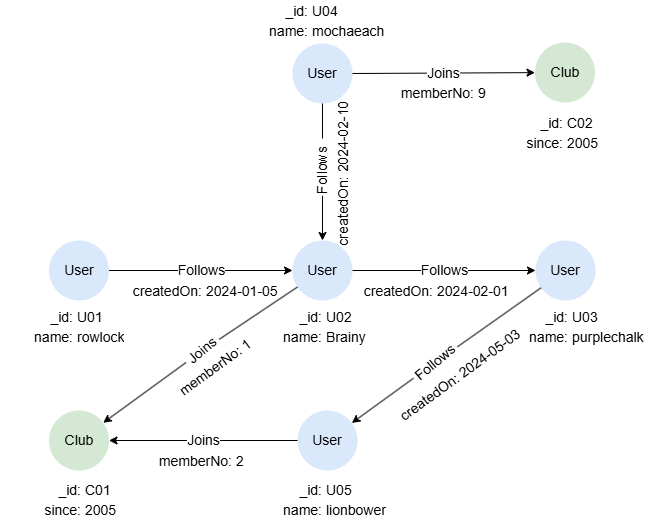
GQLINSERT (rowlock:User {_id: 'U01', name: 'rowlock'}),
       (brainy:User {_id: 'U02', name: 'Brainy'}),
       (purplechalk:User {_id: 'U03', name: 'purplechalk'}),
       (mochaeach:User {_id: 'U04', name: 'mochaeach'}),
       (lionbower:User {_id: 'U05', name: 'lionbower'}),
       (c01:Club {_id: 'C01', since: 2005}),
       (c02:Club {_id: 'C02', since: 2005}),
       (rowlock)-[:Follows {createdOn: '2024-01-05'}]->(brainy),
       (mochaeach)-[:Follows {createdOn: '2024-02-10'}]->(brainy),
       (brainy)-[:Follows {createdOn: '2024-02-01'}]->(purplechalk),
       (lionbower)-[:Follows {createdOn: '2024-05-03'}]->(purplechalk),
       (brainy)-[:Joins {memberNo: 1}]->(c01),
       (lionbower)-[:Joins {memberNo: 2}]->(c01),
       (mochaeach)-[:Joins {memberNo: 9}]->(c02)
Simple Filtering
GQLMATCH (c:Club)
FILTER c._id = "C01"
RETURN c
Result:
JSON[
  {"id": "C01", "labels": ["Club"], "properties": {"since": 2005}}
]
Filtering with Cartesian Product
This query returns users who follow Brainy and are also members of C02:
GQLMATCH (u1:User)-[:Follows]->(:User {name: "Brainy"})
MATCH (u2:User)-({_id: "C02"})
FILTER u1 = u2
RETURN u1
Result:
JSON[
  {"id": "U04", "labels": ["User"], "properties": {"name": "mochaeach"}}
]
Note that the Cartesian product is formed between u1 and u2, as they are produced by different MATCH statements, before the FILTER statement is applied to perform the filtering.