
K-Hop Traversal
Overview
The K-hop neighbors of a node are the nodes located at a shortest distance of K from that node. The shortest distance is the number of edges in the shortest path.
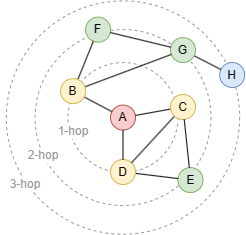
In this graph, nodes {B, C, D} are the 1-hop neighbors of node A, {E, F, G} are the 2-hop neighbors, and {H} is the 3-hop neighbor.
Key properties of K-hop neighbors:
Kis determined solely by the shortest distance and is unique. For example, there may be many paths between two nodes, butKis always the shortest. A node will only appear at one hop level.- K-hop results are deduplicated. Even if multiple shortest paths exist to the same node, it appears only once.
Ultipa provides the KHOP path mode for K-hop neighbor search, finding the distinct destination nodes reachable from a starting node within a given hop range. KHOP is well suited for reachability queries (Who can A reach in n hops?) and neighbor counts, where the question is about which nodes rather than how many distinct paths.
Syntax<k-hop traversal statement> ::= "MATCH KHOP" <quantified path pattern>
The hop range is expressed through the quantifier on the edge pattern, for example ->{2} for exactly 2 hops or ->{1,3} for 1 to 3 hops.
Details
- The starting node is not included in the result, even when a cycle leads back to it.
- Destination nodes are deduplicated; each node is returned at most once per starting node.
KHOPacceleratescount()queries via a count-only execution path.
Example Graph

GQLINSERT (alice:Person {name: 'Alice'}), (bob:Person {name: 'Bob'}),
       (carol:Person {name: 'Carol'}), (david:Person {name: 'David'}),
       (eve:Person {name: 'Eve'}), (frank:Person {name: 'Frank'}),
       (alice)-[:Knows]->(bob), (alice)-[:Knows]->(carol),
       (alice)-[:Knows]->(eve), (bob)-[:Knows]->(david),
       (carol)-[:Knows]->(eve), (david)-[:Knows]->(frank)
Exact Hop Distance
Find people exactly 2 hops away from Alice:
GQLMATCH KHOP (a:Person {name: 'Alice'})-[:Knows]->{2}(n:Person)
RETURN n.name
Result:
| n.name |
|---|
| David |
Hop Range
Find people within 1 to 2 hops from Alice:
GQLMATCH KHOP (a:Person {name: 'Alice'})-[:Knows]->{1,2}(n:Person)
RETURN n.name
Result:
| n.name |
|---|
| Carol |
| Eve |
| Bob |
| David |
Counting Reachable Neighbors
count() over a KHOP match returns the number of distinct destination nodes:
GQLMATCH KHOP (a:Person {name: 'Alice'})-[:Knows]->{1,3}(n:Person)
RETURN count(n)
Result:
| count(n) |
|---|
| 5 |
Deduplication
When multiple paths lead to the same destination node, KHOP returns that node once.
Eve is reachable from Alice directly (1 hop) and through Carol (2 hops). A 1-to-2-hop KHOP query returns Eve only once:
GQLMATCH KHOP (a:Person {name: 'Alice'})-[:Knows]->{1,2}(n:Person WHERE n.name = 'Eve')
RETURN n.name
Result:
| n.name |
|---|
| Eve |