
Questioned Paths
Overview
A questioned path makes a path pattern optional; it matches zero or one occurrence. This is useful when you want to include a connection in a pattern but it may not always exist.
A questioned path is written by appending ? to a parenthesized path pattern expression.
Syntax<questioned path pattern> ::= "(" <path pattern expression> ")" "?"
When the path exists, it is included in the result; when it doesn't, the match still succeeds with the optional part absent.
Difference from {0,1}
Although ? and {0,1} both match zero or one occurrence, they differ in how variables are exposed:
{0,1}(quantified path): Variables declared inside become group variables; they are exposed as lists (e.g., a single-element list or an empty list).?(questioned path): Variables declared inside remain singletons; they keep their original type but become conditional singletons that arenullwhen the optional path is absent.
Example Graph
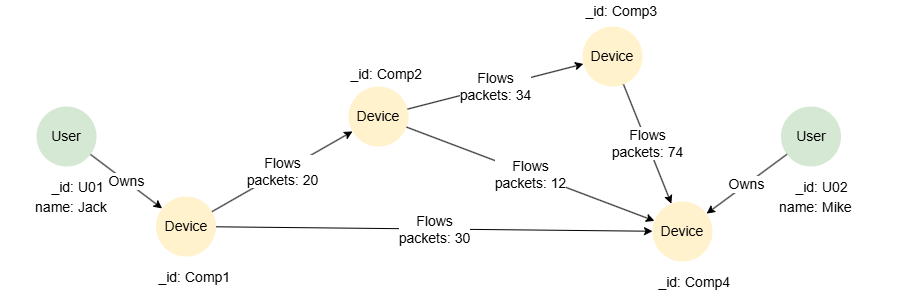
GQLINSERT (jack:User {_id: "U01", name: "Jack"}), (mike:User {_id: "U02", name: "Mike"}),
       (c1:Device {_id: "Comp1"}), (c2:Device {_id: "Comp2"}),
       (c3:Device {_id: "Comp3"}), (c4:Device {_id: "Comp4"}),
       (jack)-[:Owns]->(c1), (mike)-[:Owns]->(c4),
       (c1)-[:Flows {packets: 20}]->(c2), (c1)-[:Flows {packets: 30}]->(c4),
       (c2)-[:Flows {packets: 34}]->(c3), (c2)-[:Flows {packets: 12}]->(c4),
       (c3)-[:Flows {packets: 74}]->(c4)
Examples
Find all devices reachable from Comp1 with an optional second hop:
GQLMATCH (d1 {_id: 'Comp1'})->(d2:Device)(->(d3:Device))?
RETURN d1._id AS start, d2._id AS firstHop, d3._id AS secondHop
Result:
| start | firstHop | secondHop |
|---|---|---|
| Comp1 | Comp2 | null |
| Comp1 | Comp2 | Comp3 |
| Comp1 | Comp2 | Comp4 |
| Comp1 | Comp4 | null |
When the optional path matches, d3 contains the device. When it doesn't, d3 is null. This is because ? exposes variables as conditional singletons rather than group variables.