
Node2Vec Walk
✓ File Writeback ✕ Property Writeback ✓ Direct Return ✓ Stream Return ✕ Stats
Overview
Diverging from the classic random walk, the Node2Vec Walk is a biased random walk which can explore neighborhoods in a BFS as well as DFS fashion. Please refer to the Node2Vec algorithm for details.
Considerations
- Self-loops are also eligible to be traversed during the random walk.
- If the walk starts from an isolated node without any self-loop, the walk halts after the first step as there are no adjacent edges to proceed to.
- The Node2Vec Walk algorithm ignores the direction of edges but calculates them as undirected edges.
Syntax
- Command:
algo(random_walk_node2vec) - Parameters:
Name | Type | Spec | Default | Optional | Description |
|---|---|---|---|---|---|
| ids / uuids | []_id / []_uuid | / | / | Yes | ID/UUID of nodes to start random walks; start from all nodes if not set |
| walk_length | int | ≧1 | 1 | Yes | Depth of each walk, i.e., the number of nodes to visit |
| walk_num | int | ≧1 | 1 | Yes | Number of walks to perform for each specified node |
| edge_schema_property | []@<schema>?.<property> | Numeric type, must LTE | / | Yes | Edge property(-ies) to use as edge weight(s), where the values of multiple properties are summed up; nodes only walk along edges with the specified property(-ies) |
| p | float | >0 | 1 | Yes | The return parameter; a larger value reduces the probability of returning |
| q | float | >0 | 1 | Yes | The in-out parameter; it tends to walk at the same level when the value is greater than 1, otherwise it tends to walk far away |
| limit | int | ≧-1 | -1 | Yes | Number of results to return, -1 to return all results |
Example
The example graph is as follows, numbers on edges are the values of edge property score:
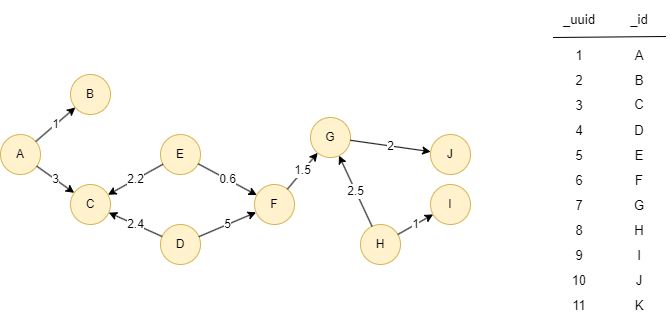
File Writeback
Spec | Content | Description |
|---|---|---|
| filename | _id,_id,... | IDs of visited nodes |
UQLalgo(random_walk_node2vec).params({
  walk_length: 6,
  walk_num: 2,
  p: 10000,
  q: 0.0001
}).write({
  file:{
    filename: 'walks'
}})
Results: File walks
FileJ,G,H,I,H,G,
I,H,G,F,E,C,
H,G,H,G,F,E,
G,H,G,H,I,H,
F,G,E,C,D,F,
E,F,E,F,G,H,
D,C,D,C,E,F,
C,D,A,B,A,C,
B,A,C,D,F,E,
A,B,A,B,A,C,
J,G,F,D,C,A,
I,H,G,F,E,C,
H,I,H,I,H,G,
G,F,D,C,E,F,
F,E,C,A,B,A,
E,F,E,F,D,C,
D,F,D,F,E,C,
C,D,A,B,A,C,
B,A,C,E,F,G,
A,C,A,C,E,F,
Direct Return
| Alias Ordinal | Type | Description | Columns |
|---|---|---|---|
| 0 | []perWalk | Array of UUIDs of visited nodes | [_uuid, _uuid, ...] |
UQLalgo(random_walk_node2vec).params({
  ids: ['J'],
  walk_length: 6,
  walk_num: 3,
  p: 2000,
  q: 0.001
}) as walks
return walks
Results: walks
| [10, 7, 6, 5, 3, 1] |
| [10, 7, 6, 5, 3, 1] |
| [10, 7, 8, 9, 8, 7] |
Stream Return
| Alias Ordinal | Type | Description | Columns |
|---|---|---|---|
| 0 | []perWalk | Array of UUIDs of visited nodes | [_uuid, _uuid, ...] |
UQLalgo(random_walk_node2vec).params({
  ids: ['A'],
  walk_length: 5,
  walk_num: 10,
  p: 1000,
  q: 1,
  edge_schema_property: 'score'
}).stream() as walks
return walks
Results: walks
| [1, 3, 4, 6, 5] |
| [1, 2, 1, 3, 5] |
| [1, 2, 1, 3, 4] |
| [1, 3, 4, 6, 7] |
| [1, 3, 4, 6, 7] |
| [1, 3, 5, 6, 7] |
| [1, 3, 5, 6, 4] |
| [1, 2, 1, 3, 5] |
| [1, 3, 4, 6, 7] |
| [1, 3, 4, 6, 5] |