
k-Core
✓ File Writeback ✕ Property Writeback ✓ Direct Return ✓ Stream Return ✕ Stats
Overview
The k-Core algorithm identifies the maximal connected subgraph where all nodes have a minimum degree of k. It is commonly employed to extract closely connected groups in a graph for further analysis. The algorithm is widely utilized in various research domains including financial risk control, social network analysis, and biology. One of the key advantages of the k-Core algorithm is its low time complexity (linear), making it efficient for large-scale graph processing. Additionally, the resulting subgraphs have good intuitive interpretability, aiding in the understanding of the graph's structural patterns and relationships.
The commonly accepted concept of k-core was first proposed by Seidman:
- S.B. Seidman, Network Structure And Minimum Degree. Soc Netw 5:269-287 (1983)
Concepts
k-Core
The k-core of a graph is obtained through an iterative pruning process. Starting with the original graph, nodes with a degree less than k are successively removed until only nodes with degrees greater than or equal to k remain.
Below is the pruning process to get the 3-core of the graph. In the first round, nodes {a, d, f} with degree less than 3 are removed , which then affects the removal of node b in the second round. After the second round, all remaining nodes have a degree of at least 3. Therefore, the pruning process ends, and the 3-core of this graph is induced by nodes {c, e, g, h}.

Ultipa's k-Core algorithm identifies the k-core in each connected component.
Considerations
- The k-Core algorithm ignores self-loops in the graph. Any self-loop present is not considered when calculating the degree of the respective node.
- The k-Core algorithm ignores the direction of edges but calculates them as undirected edges.
Syntax
- Command:
algo(k_core) - Parameters:
Name | Type | Spec | Default | Optional | Description |
|---|---|---|---|---|---|
| k | int | ≥1 | / | No | Each node in the k-core has a degree that is equal to or greater than k |
Examples
The example graph is as follows:
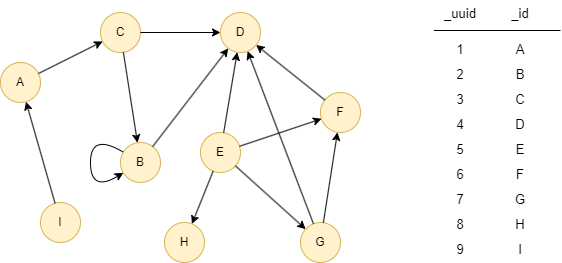
File Writeback
Spec | Content | Description |
|---|---|---|
| filename | _id | ID of node in the k-core |
UQLalgo(k_core).params({
  k: 3
}).write({
  file:{
    filename: '3-core'
  }
})
Results: File 3-core
FileG
F
E
D
Direct Return
Alias Ordinal | Type | Description |
|---|---|---|
| 0 | []perNode | UUIDs of nodes in the k-core |
UQLalgo(k_core).params({
  k: 2
}) as k2
return k2
Results: k2
| 7 |
| 6 |
| 5 |
| 4 |
| 2 |
| 3 |
Stream Return
Alias Ordinal | Type | Description |
|---|---|---|
| 0 | []perNode | UUIDs of nodes in the k-core |
UQLalgo(k_core).params({
  k: 2
}).stream() as k2
find().nodes(k2) as nodes
return nodes{*}
Results: nodes
| _id | _uuid |
|---|---|
| G | 7 |
| F | 6 |
| E | 5 |
| D | 4 |
| C | 2 |
| B | 3 |