
Fast Random Projection
✓ File Writeback ✕ Property Writeback ✓ Direct Return ✓ Stream Return ✕ Stats
Overview
Fast Random Projection (or FastRP) is a scalable and performant algorithm for learning node representations in a graph. It achieves an iterative computation of node embeddings with two components: first, node similarity matrix construction; second, dimension reduction by random projection.
FastRP was proposed by H. Chen et al. in 2019:
- H. Chen, S.F. Sultan, Y. Tian, M. Chen, S. Skiena, Fast and Accurate Network Embeddings via Very Sparse Random Projection (2019)
FastRP Framework
The authors of FastRP propose that most network embedding methods essentially consist of two components: (1) construct a node similarity matrix or implicitly sample node pairs from it, and then (2) apply dimension reduction techniques to this matrix.
Regarding the dimension reduction, many popular algorithms, like Node2Vec, rely on time-consuming methods such as Skip-gram. The authors argue that the success of these methods should be attributed to the proper construction of this similarity matrix, rather than the dimension reduction method employed.
Therefore, FastRP utilizes very sparse random projection, which is a scalable optimization-free method for dimension reduction.
Very Sparse Random Projection
Random projection is a dimension reduction method that roughly preserves the relative pairwise distances between data points when embedding them from the high-dimensional space into a lower-dimensional space. The theoretical guarantees of random projection are mainly derived from the Johnson-Lindenstrauss Lemma.
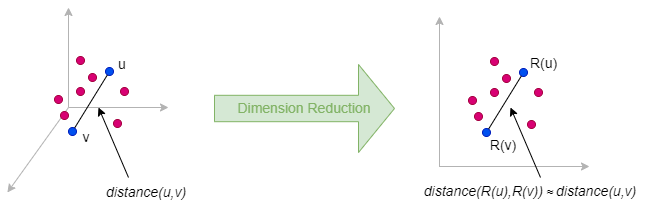
The idea behind random projection is very simple: to reduce a matrix Mn×m (for graph data, we have n = m) to a matrix Nn×d where d ≪ n, we can simply multiply M with an random projection matrix Rm×d: N = M ⋅ R**.
The matrix R is generated by sampling its entries independently from a random distribution. Specifically, FastRP considers the very sparse random projection method for dimension reduction, where entries of R are sampled from the following distribution:
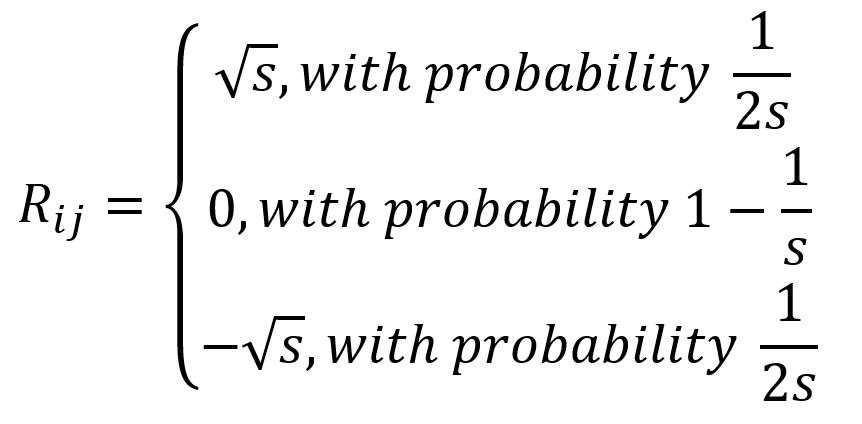
and s=sqrt(m).
Very sparse random projection has superior computation efficiency as it only requires matrix multiplication, and (1-1/s) of the entries of R are zero.
Additionally, Ultipa supports to initialize the matrix R with a combination with some selected numeric node properties (features). In this case, each row in matrix R is formed by concatenation of two parts:

- Elements d1 ~ dx are generated by the Very Sparse Random Projection algorithm.
- Elements p1 ~ py is a linear combination of the selected node property values.
- x + y equals to the dimension of the final embeddings, where y is referred to as the property dimension.
- The number of selected node features doesn't have to be the same as the property dimension.
Node Similarity Matrix Construction
FastRP keeps two key features when constructing node similarity matrix:
- Preserve high-order proximity in the graph
- Perform element-wise normalization on the matrix
Let S be the adjacency matrix of graph G =(V,E), D be the degree matrix, and A be the transition matrix and A = D-1S. See the example below, the number on each edge represents the edge weight:

The fact is that in matrix A, entry Aij stands for the probability of node i reaching to node j with 1-step random walk. Furthermore, if raises A to k-th power to get matrix Ak, then Akij denotes the probability of reaching node j from node i in k steps of random walk. Hence, matrix Ak preserves high-order proximity of the graph.
However, as k → ∞, it can be proved that Akij → dj/2m where m = |E|, and dj is the degree of the j-th node. Since many real-world graphs are scale-free, the entries in Ak follow a heavy-tailed distribution. This implies that the pairwise distances between data points in Ak are predominantly influenced by columns with exceptionally large values, making them less meaningful and posing challenges for the next dimension reduction step.
To address this, FastRP further performs normalization on matrix Ak by multiplying it with a diagonal normalization matrix L, where Lij = (dj/2m)β, and β is the normalization strength. The normalization strength controls the impact of node degree on the embeddings: when β is negative, the importance of high-degree neighbors is weakened, and the opposite when β is positive.
Algorithm Process
The FastRP algorithm follows these steps:
- Generate the random projection matrix R.
- Reduce the dimension of the normalized 1-step transition matrix: N1 = A ⋅ L ⋅ R
- Reduce the dimension of the normalized 2-step transition matrix: N2 = A ⋅ (A ⋅ L ⋅ R) = A ⋅ N1
- Repeat step 3 until the normalized k-step transition matrix: Nk = A ⋅ Nk-1
- Generate the weighted combination of different powers of A: N = α1N1 + ... + αkNk, where α1,...,αk are the iteration weights.
NOTEThe efficiency of FastRP also benefits from the associative property of matrix multiplication. It doesn't calculate Ak from scratch as the computation can be done iteratively.
Considerations
- The FastRP algorithm ignores the direction of edges but calculates them as undirected edges.
Syntax
- Command:
algo(fastRP) - Parameters:
Name | Type | Spec | Default | Optional | Description |
|---|---|---|---|---|---|
| dimension | int | ≥2 | / | No | Dimensionality of the embeddings |
| normalizationStrength | float | / | / | Yes | Normalization strength β |
| iterationWeights | []float | >0 | [0.0,1.0,1.0] | Yes | Weight for each iteration, the size of the array is the number of iterations |
| edge_schema_property | []@<schema>?.<property> | Numeric type, must LTE | / | Yes | Edge property(-ies) to be used as edge weight(s), where the values of multiple properties are summed up |
| node_schema_property | []@<schema>?.<property> | Numeric type, must LTE | / | Yes | Node property(-ies) to be used as feature(s); propertyDimension and node_schema_property should be configured together or both ignored |
| propertyDimension | int | (0,dimension] | / | Yes | Length of the property dimension; propertyDimension and node_schema_property should be configured together or both ignored |
| limit | int | ≥-1 | -1 | Yes | Number of results to return, -1 to return all results |
Example
File Writeback
| Spec | Content |
|---|---|
| filename | _id, embedding_result |
UQLalgo(fastRP).params({
  dimension : 10,
  normalizationStrength: 1.5,
  iterationWeights: [0, 0.8, 0.2, 1],
  edge_schema_property: ['w1', 'w2'],
  node_schema_property: ['@default.f1', '@default.f2'],
  propertyDimension: 3
}).write({
  file:{
    filename: 'embedding'
  }
})
Property Writeback
| Spec | Content | Write to | Data Type |
|---|---|---|---|
| property | embedding_result | Node Property | string |
UQLalgo(fastRP).params({
  dimension : 10,
  normalizationStrength: 1.5,
  iterationWeights: [0, 0.8, 0.2, 1],
  edge_schema_property: ['w1', 'w2']
}).write({
  db:{
    property: 'embedding'
  }
})
Direct Return
| Alias Ordinal | Type | Description | Columns |
|---|---|---|---|
| 0 | []perNode | Node and its embeddings | _uuid, embedding_result |
UQLalgo(fastRP).params({
  dimension : 10,
  normalizationStrength: 1.5,
  iterationWeights: [0, 0.8, 0.2, 1]
}) as embeddings
return embeddings
Stream Return
| Alias Ordinal | Type | Description | Columns |
|---|---|---|---|
| 0 | []perNode | Node and its embeddings | _uuid, embedding_result |
UQLalgo(fastRP).params({
  dimension : 10,
  normalizationStrength: 1.5,
  iterationWeights: [0, 0.8, 0.2, 1]
}).stream() as embeddings
return embeddings