
Eigenvector Centrality
✓ File Writeback ✓ Property Writeback ✓ Direct Return ✓ Stream Return ✕ Stats
Overview
Eigenvector centrality measures the power or influence of a node. In a directed network, the power of a node comes from its incoming neighbors. Thus, the eigenvector centrality score of a node depends not only on how many in-links it has, but also on how powerful its incoming neighbors are. Connections from high-scoring nodes contribute more to the score of the node than connections from low-scoring nodes. In the disease spreading scenario, a node with higher eigenvector centrality is more likely to be close to the source of infection, which needs special precautions.
The well-known PageRank is a variant of eigenvector centrality.
Eigenvector centrality takes on values between 0 to 1, nodes with higher scores are more influential in the network.
Concepts
Eigenvector Centrality
The power (score) of each node can be computed in a recursive way. Take the graph below as as example, adjacent matrix A reflects the in-links of each node. Initialzing that each node has score of 1 and it is represented by vector s(0).
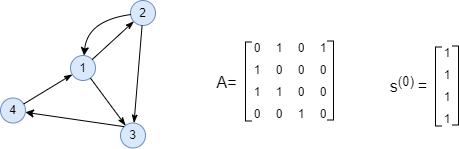
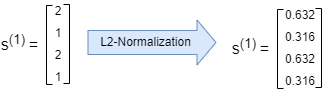
In each round of power transition, update the score of each node by the sum of scores of all its incoming neighbors. After one round, vector s(1) = As(0) is as follows, L2-normalization is applied to rescale:
After k iterations, s(k) = As(k-1) = Aks(0). As k grows, s(k) stabilizes. In this example, the stablization is reached after ~20 rounds.
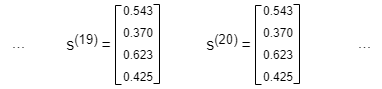
In fact, s(k) converges to the eigenvector of matrix A that corresponds to the largest absolute eigenvalue, hence elements in s(k) is referred to as eigenvector centrality.
Eigenvalue and Eigenvector
Given A is an n x n square matrix, λ is a constant, x is an non-zero n x 1 vector. If the equation Ax = λx is true, then λ is called the eigenvalue of A, and x is the eigenvector of A that corresponds to the eigenvalue λ.
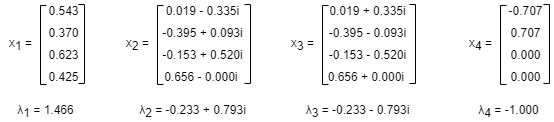
The above matrix A has 4 eigenvalues λ1, λ2, λ3 and λ4 that correspond to eigenvectors x1, x2, x3 and x4 respectively. x1 is the eigenvector corresponding to the dominate eigenvalue λ1 that has the largtest absolute value.
According to the Perron-Forbenius theorem, if matrix A has eigenvalues |λ1| > |λ2| ≥ |λ3| ≥ ... ≥ |λn|, as k → ∞, the direction of s(k) = Aks(0) converges to x1, and s(0) can be any nonzero vector.
Power Iteration
For the best computation efficiency and accuracy, this algorithm adopts the power iteration approach to compute the dominate eigenvector (x1) of matrix A:
- s(1) = As(0)
- s(2) = As(1) = A2s(0)
- ...
- s(k) = As(k-1) = Aks(0)
The algorithm continues until s(k) converges to within some tolerance, or the maximum iteration rounds is met.
Considerations
- The algorithm uses the sum of adjacency matrix and unit matrix (i.e., A = A + I) rather than the adjacency matrix only in order to guarantee the covergence.
- The eigenvector centrality score of nodes with no in-link converges to 0.
- Self-loop is counted as one in-link, its weight counted only once (weighted graph).
Syntax
- Command:
algo(eigenvector_centrality) - Parameters:
Name | Type | Spec | Default | Optional | Description |
|---|---|---|---|---|---|
| max_loop_num | int | ≥1 | 20 | Yes | Maximum rounds of iterations; the algorithm ends after running for all rounds, even though the condition of tolerance is not met |
| tolerance | float | (0,1) | 0.001 | Yes | When all scores change less than the tolerance between iterations, the result is considered stable and the algorithm ends |
| edge_weight_property | @<schema>?.<property> | Numeric type, must LTE | / | Yes | Edge property(-ies) to use as edge weight(s), where the values of multiple properties are summed up |
| direction | string | in, out | / | Yes | Constructs the adjacent matrix A with the in-links (in) or our-links (out) of each node |
| limit | int | ≥-1 | -1 | Yes | Number of results to return, -1 to return all results |
| order | string | asc, desc | / | Yes | Sort nodes by the centrality score |
Examples
The example is a web network, edge property @link.value can be used as weights:
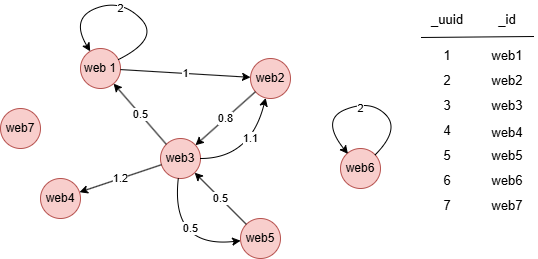
File Writeback
| Spec | Content |
|---|---|
| filename | _id,rank |
UQLalgo(eigenvector_centrality).params({
  max_loop_num: 15,
  tolerance: 0.01,
  direction: "in"
}).write({
    file: {
      filename: 'rank'
    }
})
Results: File rank
Fileweb7,4.63007e-06
web6,0.0198426
web5,0.255212
web3,0.459901
web4,0.255214
web2,0.573512
web1,0.573511
Property Writeback
| Spec | Content | Write to | Data Type |
|---|---|---|---|
| property | rank | Node property | float |
UQLalgo(eigenvector_centrality).params({
  edge_weight_property: 'value'
}).write({
    db: {
      property: 'ec'
    }
})
Results: Centrality score for each node is written to a new property named ec
Direct Return
| Alias Ordinal | Type | Description | Columns |
|---|---|---|---|
| 0 | []perNode | Node and its centrality | _uuid, rank |
UQLalgo(eigenvector_centrality).params({
  max_loop_num: 20,
  tolerance: 0.01,
  edge_weight_property: '@link.value',
  direction: "in",
  order: 'desc'
}) as ec
return ec
Results: ec
| _uuid | rank |
|---|---|
| 1 | 0.73133802 |
| 6 | 0.48346400 |
| 2 | 0.43551901 |
| 3 | 0.17412201 |
| 4 | 0.098612003 |
| 5 | 0.041088000 |
| 7 | 0.0000000 |
Stream Return
| Alias Ordinal | Type | Description | Columns |
|---|---|---|---|
| 0 | []perNode | Node and its centrality | _uuid, rank |
Example: Calculate weighted eigenvector centrality for all nodes, count the number of nodes with score above 0.4 or otherwise respectively
UQLalgo(eigenvector_centrality).params({
  edge_weight_property: '@link.value',
  direction: "in"
}).stream() as ec
with case
when ec.rank > 0.4 then 'attention'
when ec.rank <= 0.4 then 'normal'
END as r
group by r
return table(r, count(r))
Results: table(r, count(r))
| r | count(r) |
|---|---|
| attention | 3 |
| normal | 4 |