
Dijkstra's Single-Source Shortest Path
✓ File Writeback ✕ Property Writeback ✓ Direct Return ✓ Stream Return ✕ Stats
Overview
The single-source shortest path (SSSP) problem is that of computing, for each node that is reachable from the source node, the shortest path with the minimum total edge weights among all possible paths; or in the case of unweighted graphs, the shortest path with the minimum number of edges. The cost (or distance) of the shortest path is the total edge weights or the number of edges.
The original Dijkstra's algorithm was conceived by Dutch computer scientist Edsger W. Dijkstra in 1956 to find the shortest path between two given nodes. Single-source shortest path is a common variant, facilitating effective path planning and network analysis.
Concepts
Dijkstra's Single-Source Shortest Path
Below is the basic implementation of the Dijkstra's Single-Source Shortest Path algorithm, along with an example to compute the weighted shortest paths in an undirected graph starting from the source node b:
1. Create a priority queue to store nodes and their corresponding distances from the source node. Initialize the distance of the source node as 0 and the distances of all other nodes as infinity. All node are marked as unvisited.
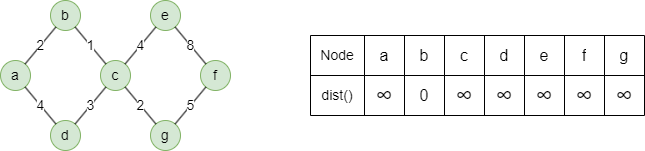
2. Extract the node with the minimum distance from the queue and mark it as visited, relax all its unvisited neighbors.
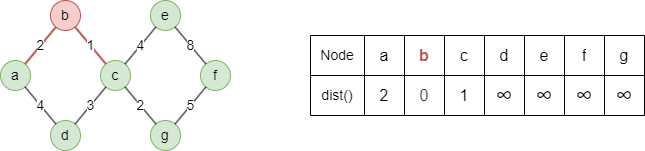
dist(a) = min(0+2,∞) = 2, dist(c) = min(0+1,∞) = 1
NOTEThe term relaxation refers to the process of updating the distance of a node v that is connected to node u to a potential shorter distance by considering the path through node u. Specifically, the distance of node v is updated to dist(v) = dist(u) + w(u,v), where w(u,v) is the weight of the edge (u,v). This update is performed only if the current dist(v) is greater than dist(u) + w(u,v).
NOTEOnce a node has been marked as visited, its shortest path has been fixed and its distance will not change during the rest of the algorithm. The algorithm only updates the distances of node that have not been visited yet.
3. Repeat step 2 until all nodes are visited.
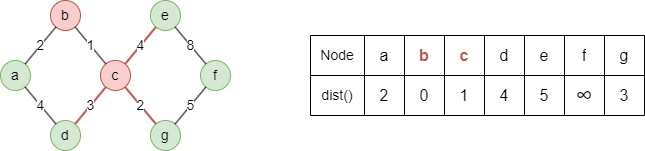
dist(d) = min(1+3, ∞) = 4, dist(e) = min(1+4, ∞) = 5, dist(g) = min(1+2, ∞) = 3
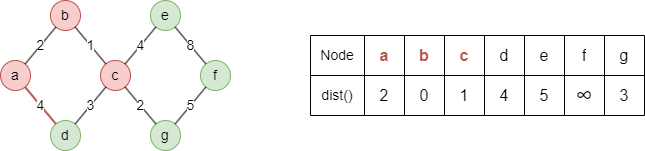
dist(d) = min(2+4, 4) = 4
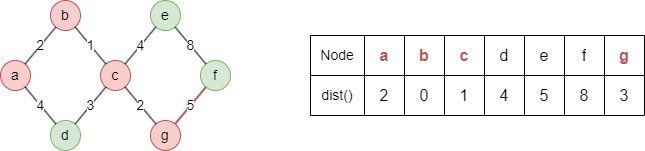
dist(f) = min(3+5, ∞) = 8
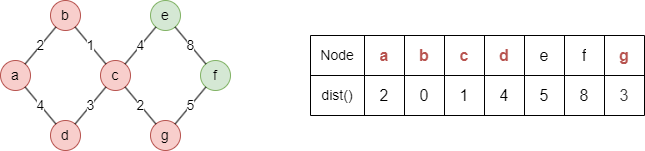
No neighbor can be relaxed
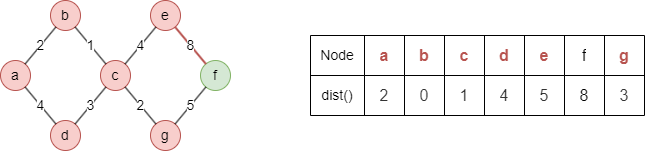
dist(f) = min(5+8, 8) = 8
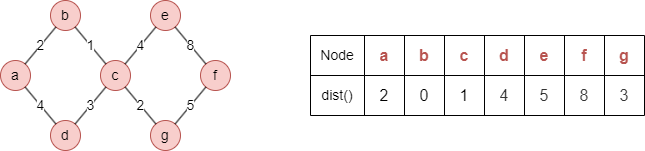
No neighbor can be relaxed
The algorithm ends here as all nodes are visited
Considerations
- The Dijkstra's algorithm is only applicable to graphs with non-negative edge weights. If negative weights are present, the Dijkstra's algorithm might produce false results. In this case, a different algorithm like the SPFA should be used.
- If there are multiple shortest paths exist between two nodes, all of them will be found.
- In disconnected graphs, the algorithm only outputs the shortest paths from the source node to all nodes belonging to the same connected component as the source node.
Syntax
- Command:
algo(sssp) - Parameters:
Name | Type | Spec | Default | Optional | Description |
|---|---|---|---|---|---|
| ids / uuids | _id / _uuid | / | / | No | ID/UUID of the single source node |
| direction | string | in, out | / | Yes | Direction of the shortest path, ignore the edge direction if not set |
| edge_schema_property | []@schema?.property | Numeric type, must LTE | / | Yes | One or multiple edge properties to be used as edge weights, where the values of multiple properties are summed up; treat the graph as unweighted if not set |
| record_path | int | 0, 1 | 0 | Yes | 1 to return the shortest paths, 0 to return the shortest distances |
| sssp_type | string | dijkstra | dijkstra | Yes | To run the Dijkstra's SSSP algorithm, keep it as dijkstra |
| limit | int | ≥-1 | -1 | Yes | Number of results to return, -1 to return all results |
| order | string | asc, desc | / | Yes | Sort nodes by the shortest distance from the source node |
Examples
The example graph is as follows:
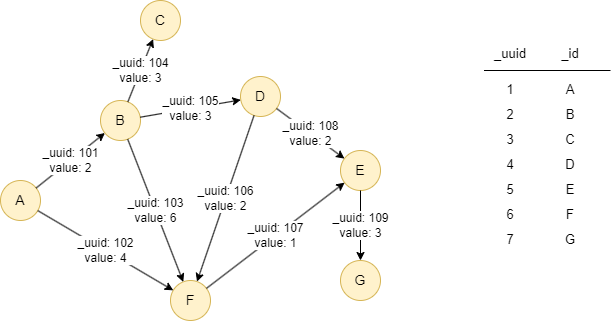
File Writeback
| Spec | record_path | Content | Description |
|---|---|---|---|
| filename | 0 | _id,totalCost | The shortest distance/cost from the source node to each other node |
| 1 | _id--_uuid--_id | The shortest path from the source node to each other node, the path is represented by the alternating ID of nodes and UUID of edges that form the path |
UQLalgo(sssp).params({
  uuids: 1,
  edge_schema_property: '@default.value'
}).write({
  file: {
    filename: 'costs'
  }
})
Results: File costs
FileG,8
F,4
E,5
D,5
C,5
B,2
A,0
UQLalgo(sssp).params({
  uuids: 1,
  edge_schema_property: '@default.value',
  sssp_type: 'dijkstra',
  record_path: 1
}).write({
  file: {
    filename: 'paths'
  }
})
Results: File paths
FileA--[102]--F--[107]--E--[109]--G
A--[102]--F--[107]--E
A--[101]--B--[105]--D
A--[101]--B--[104]--C
A--[102]--F
A--[101]--B
A
Direct Return
| Alias Ordinal | record_path | Type | Description | Columns |
|---|---|---|---|---|
| 0 | 0 | []perNode | The shortest cost/distance from the source node to each other node | _uuid, totalCost |
| 1 | []perPath | The shortest path from the source node to each other node, the path is represented by the alternating UUID of nodes and UUID of edges that form the path | / |
UQLalgo(sssp).params({
  uuids: 1,
  edge_schema_property: '@default.value',
  sssp_type: 'dijkstra',
  record_path: 0,
  order: 'desc'
}) as costs
return costs
Results: costs
| _uuid | totalCost |
|---|---|
| 7 | 8 |
| 5 | 5 |
| 4 | 5 |
| 3 | 5 |
| 6 | 4 |
| 2 | 2 |
| 1 | 0 |
UQLalgo(sssp).params({
  ids: 'A',
  edge_schema_property: '@default.value',
  direction: 'out',
  record_path: 1,
  order: 'asc'
}) as paths
return paths
Results: paths
| 1 |
| 1--[101]--2 |
| 1--[102]--6 |
| 1--[102]--6--[107]--5 |
| 1--[101]--2--[105]--4 |
| 1--[101]--2--[104]--3 |
| 1--[102]--6--[107]--5--[109]--7 |
Stream Return
| Alias Ordinal | record_path | Type | Description | Columns |
|---|---|---|---|---|
| 0 | 0 | []perNode | The shortest cost/distance from the source node to each other node | _uuid, totalCost |
| 1 | []perPath | The shortest path from the source node to each other node, the path is represented by the alternating UUID of nodes and UUID of edges that form the path | / |
UQLalgo(sssp).params({
  uuids: 1,
  edge_schema_property: '@default.value',
  sssp_type: 'dijkstra'
}).stream() as costs
where costs.totalCost <> [0,5]
return costs
Results: costs
| _uuid | totalCost |
|---|---|
| 6 | 4 |
| 2 | 2 |
UQLalgo(sssp).params({
  ids: 'A',
  edge_schema_property: '@default.value',
  record_path: 1
}).stream() as p
where length(p) <> [0,3]
return p
Results: p
| 1--[102]--6--[107]--5 |
| 1--[101]--2--[105]--4 |
| 1--[101]--2--[104]--3 |
| 1--[102]--6 |
| 1--[101]--2 |