
Common Neighbors
✓ File Writeback ✕ Property Writeback ✓ Direct Return ✓ Stream Return ✕ Stats
Overview
The Common Neighbors algorithm computes the number of common neighbors between two nodes as a measure of their similarity.
The logic behind this algorithm is that if two nodes have a high number of neighbors in common, they are likely to be similar or connected in some meaningful way. It is computed using the following formula:

where N(x) and N(y) are the sets of adjacent nodes to nodes x and y respectively.
More common neighbors indicate greater similarity between nodes, while a number of 0 indicates no similarity between two nodes.
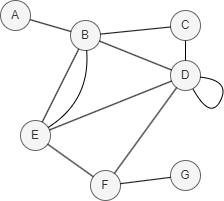
In this example, CN(D,E) = |N(D) ∩ N(E)| = |{B, F}| = 2.
Considerations
- The Common Neighbors algorithm ignores the direction of edges but calculates them as undirected edges.
Syntax
- Command:
algo(topological_link_prediction) - Parameters:
Name | Type | Spec | Default | Optional | Description |
|---|---|---|---|---|---|
| ids / uuids | []_id / []_uuid | / | / | No | ID/UUID of the first set of nodes to calculate; each node in ids/uuids will be paired with each node in ids2/uuids2 |
| ids2 / uuids2 | []_id / []_uuid | / | / | No | ID/UUID of the second set of nodes to calculate; each node in ids/uuids will be paired with each node in ids2/uuids2 |
| type | string | Common_Neighbors | Adamic_Adar | No | Type of similarity; for Common Neighbors, keep it as Common_Neighbors |
| limit | int | >=-1 | -1 | Yes | Number of results to return, -1 to return all results |
Example
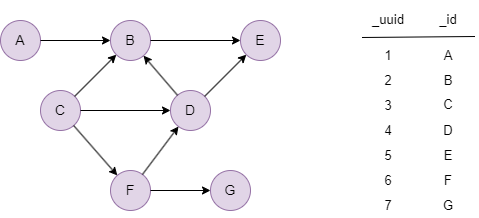
The example graph is as follows:
File Writeback
| Spec | Content |
|---|---|
| filename | node1,node2,num |
UQLalgo(topological_link_prediction).params({
  uuids: [3],
  uuids2: [1,5,7],
  type: 'Common_Neighbors'
}).write({
  file:{
    filename: 'cn'
  }
})
Results: File cn
FileC,A,1.000000
C,E,2.000000
C,G,1.000000
Direct Return
| Alias Ordinal | Type | Description | Columns |
|---|---|---|---|
| 0 | []perNodePair | Node pair and its similarity | node1, node2, num |
UQLalgo(topological_link_prediction).params({
  ids: 'C',
  ids2: ['A','C','E','G'],
  type: 'Common_Neighbors'
}) as cn
return cn
Results: cn
| node1 | node2 | num |
|---|---|---|
| 3 | 1 | 1 |
| 3 | 5 | 2 |
| 3 | 7 | 1 |
Stream Return
| Alias Ordinal | Type | Description | Columns |
|---|---|---|---|
| 0 | []perNodePair | Node pair and its similarity | node1, node2, num |
UQLfind().nodes() as n
with collect(n._id) as nID
algo(topological_link_prediction).params({
  ids: 'C',
  ids2: nID,
  type: 'Common_Neighbors'
}).stream() as cn
where cn.num >= 2
return cn
Results: cn
| node1 | node2 | num |
|---|---|---|
| 3 | 4 | 2 |
| 3 | 5 | 2 |