
Induced Subgraph
✓ File Writeback ✕ Property Writeback ✓ Direct Return ✓ Stream Return ✕ Stats
Overview
The Induced Subgraph algorithm is used to compute the induced subgraph of a given set of nodes in a graph. It provides a way to focus on the immediate connections and gain insights into the local structure and interactions within the selected subset of nodes.
Concepts
Induced Subgraph
An induced subgraph includes only the nodes from the given set and the edges that connect those nodes.
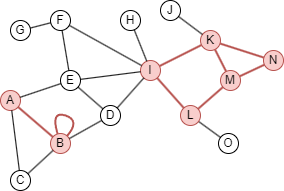
As this example shows, when specifying node set S = {A, B, I, K, L, M, N}, the induced subgraph is the graph whose node set is S and whose edge set contains all edges that have both endpoints in S.
Ultipa's Induced Subgraph algorithm returns all the 1-step paths in the induced subgraph.
Considerations
- The Induced Subgraph algorithm ignores the direction of edges but calculates them as undirected edges.
Syntax
- Command:
algo(subgraph) - Parameters:
Name | Type | Spec | Default | Optional | Description |
|---|---|---|---|---|---|
| ids / uuids | []_id / []_uuid | / | / | No | ID/UUID of the nodes to calculate |
| limit | int | ≥-1 | -1 | Yes | Number of results to return, -1 to return all results |
Examples
The example graph is as follows:
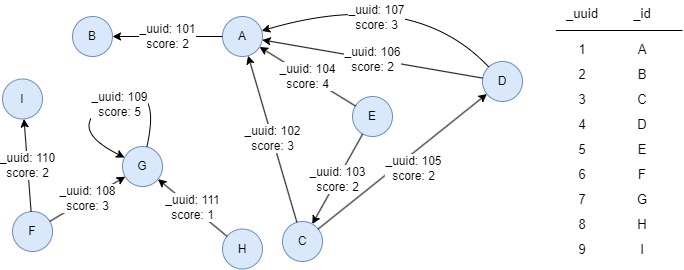
File Writeback
Spec | Content | Description |
|---|---|---|
| filename | _id--[_uuid]--_id | One-step path in the induced subgraph: (start node)--(edge)--(end node) |
UQLalgo(subgraph).params({
  ids: ['A','C','D','G']
}).write({
  file:{
    filename: 'paths'
    }
})
Results: File paths
FileC--[102]--A
C--[105]--D
D--[107]--A
D--[106]--A
G--[109]--G
Direct Return
Alias Ordinal | Type | Description |
|---|---|---|
| 0 | []path | One-step path in the induced subgraph: _uuid (start node) -- [_uuid] (edge) -- _uuid (end node) |
UQLalgo(subgraph).params({
  ids: ['A','C','D','G']
}) as subgraph
return subgraph
Results: subgraph
| 3--[102]--1 |
| 3--[105]--4 |
| 4--[107]--1 |
| 4--[106]--1 |
| 7--[109]--7 |
Stream Return
Alias Ordinal | Type | Description |
|---|---|---|
| 0 | []path | One-step path in the induced subgraph: _uuid (start node) -- [_uuid] (edge) -- _uuid (end node) |
UQLalgo(subgraph).params({
  uuids: [6,7]
}).stream() as p
with pedges(p) as e
find().edges(e) as edges
return max(edges.score)
Results: 5