
Breadth-First Seach (BFS)
✓ File Writeback ✕ Property Writeback ✕ Direct Return ✕ Stream Return ✕ Stats
Overview
Graph traversal is a search technique used to visit and explore all the nodes of a graph systematically. The primary goal of graph traversal is to uncover and examine the structure and connections of the graph. There are two common strategies for graph traversal:
- Breadth-First Seach (BFS)
- Depth-First Search (DFS)
The Breadth-First Search (BFS) algorithm explores a graph layer by layer and follows these steps:
- Create a queue (first in, first out) to keep track of visited nodes.
- Start from a selected node, enqueue it into the queue, and mark it as visited.
- Dequeue a node from the front of the queue, enqueue all its unvisited neighbors into the queue and mark them as visited.
- Repeat step 3 until the queue is empty.
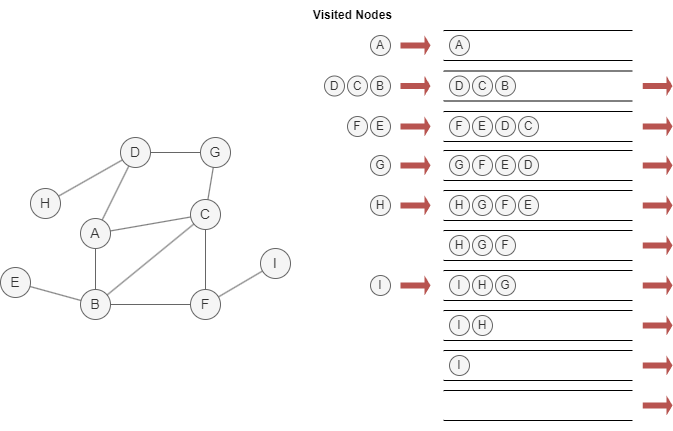
Below is an example of traversing the graph using the BFS approach, starting from node A and assuming to visit neighbors in alphabetical order (A~Z):
Considerations
- Only nodes that are in the same connected component as the start node can be traversed. Nodes in different connect components will not be included in the traversal results.
Syntax
- Command:
algo(traverse) - Parameters:
Name | Type | Spec | Default | Optional | Description |
|---|---|---|---|---|---|
| ids / uuids | _id / _uuid | / | / | No | ID/UUID of the start node to traverse the graph |
| direction | string | in, out | / | Yes | Direction of edges when traversing the graph |
| traverse_type | string | bfs | bfs | Yes | To traverse the graph in the BFS approach, keep it as bfs |
Examples
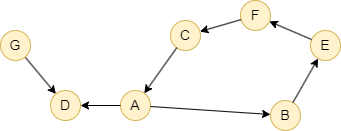
File Writeback
Spec | Content | Description |
|---|---|---|
| filename | _id,_id | The visited node (toNode), and the node from which it is visited (fromNode) |
UQLalgo(traverse).params({
  ids: ['A'],
  direction: 'out',
  traverse_type: 'bfs'
}).write({
  file: {
      filename: 'result'
  }
})
Results: File result
FileF,E
E,B
D,A
C,F
B,A
A,A