
Autonet
Overview
The autonet().src().dest().depth() statement retrieves paths between nodes.
When two sets of nodes are provided, the query attempts to find paths between each node in the source set and each node in the destination set. If only one set of nodes is given, each node in the set is paired with all other nodes in the same set to search for paths.
Syntax
Syntaxautonet().src(<filter?>).dest(<filter?>).depth(<range>)
- Statement alias: Type
PATH - Methods:
Method | Param | Description | Optional | Alias Type |
|---|---|---|---|---|
src() | <filter?> | The filtering condition enclosed in {}, or an alias to specify the set of nodes as traversal sources. If left blank, all nodes are targeted. | No | NODE |
dest() | <filter?> | The filtering condition enclosed in {}, or an alias to specify the set of nodes as traversal destinations. If left blank, all nodes are targeted. If omitted, paths will be found only between nodes specified in src(). | Yes | NODE |
depth() | <range> | The number of steps to travese (N≥1):
| No | N/A |
shortest() | <weight?> | Leaves it blank to find unweighted shortest paths or specifies a numeric edge property in the format @<schema>.<property> to find weighted shortest paths. The property shouldn't have negative values, and edges without these properties are disregarded. Only supports depth(N) for the shortest paths within N steps. | Yes | N/A |
node_filter() | <filter?> | The filtering condition enclosed in {} for all intermediate nodes in the paths. If left blank, no restriction is applied. | Yes | N/A |
edge_filter() | <filter?> | The filtering condition enclosed in {} for edges in the paths. If left blank, no restriction is applied. | Yes | N/A |
path_ascend() | <property> | Specifies a numeric edge property in the format @<schema>.<property> to find paths where this property values ascend from src() to dest(); edges without these properties are disregarded. | Yes | N/A |
path_descend() | <property> | Specifies a numeric edge property in the format @<schema>.<property> to find paths where this property values descend from src() to dest(); edges without these properties are disregarded. | Yes | N/A |
direction() | <leftRight> | Specifies the direction of all edges in the paths, which can be left or right. | Yes | N/A |
no_circle() | / | Excludes paths that form circles. A path has circles when it has repeated nodes. An exception is when src() and dest() specify the same node and that node does not appear as an intermediate node, the corresponding paths will still be returned. | Yes | N/A |
limit() | <N> | Limits the number of paths (N≥-1) returned for each node pair; -1 includes all paths. | Yes | N/A |
Example Graph
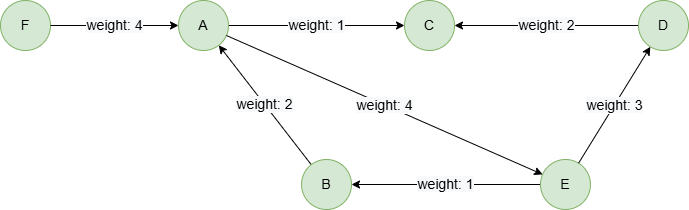
To create the graph, execute each of the following UQL queries sequentially in an empty graphset:
UQLcreate().edge_property(@default, "weight", int32)
insert().into(@default).nodes([{_id:"A"}, {_id:"B"}, {_id:"C"}, {_id:"D"}, {_id:"E"}, {_id:"F"}])
insert().into(@default).edges([{_from:"A", _to:"C", weight:1}, {_from:"E", _to:"B", weight:1}, {_from:"A", _to:"E", weight:4}, {_from:"D", _to:"C", weight:2}, {_from:"E", _to:"D", weight:3}, {_from:"B", _to:"A", weight:2}, {_from:"F", _to:"A", weight:4}])
Finding Paths of Varying Depths
Within N Steps
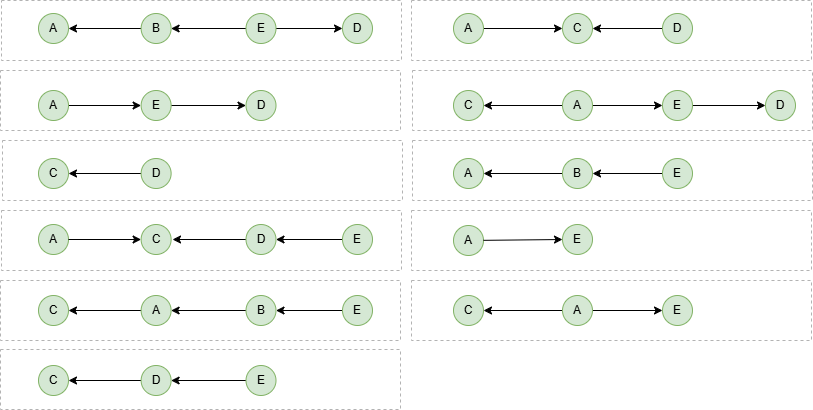
To find paths within 3 steps between nodes A, C and nodes D, E:
UQLautonet().src({_id in ["A", "C"]}).dest({_id in ["D", "E"]}).depth(:3) as p
return p
Result: p
Exact N Steps
To find paths with exact 3 steps between nodes A, C and nodes D, E:
UQLautonet().src({_id in ["A", "C"]}).dest({_id in ["D", "E"]}).depth(3) as p
return p
Result: p

Within N to M Steps
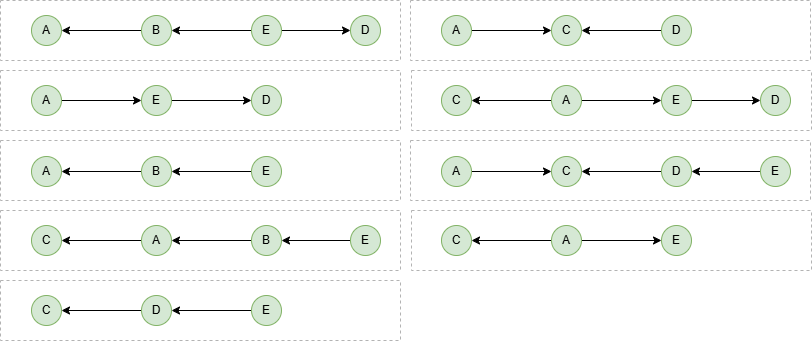
To find paths with 2 to 3 steps between nodes A, C and nodes D, E:
UQLautonet().src({_id in ["A", "C"]}).dest({_id in ["D", "E"]}).depth(2:3) as p
return p
Result: p
Finding Unweighted Shortest Paths
To find the shortest paths within 5 steps between node A and node D:
UQLautonet().src({_id == "A"}).dest({_id == "D"}).depth(5).shortest() as p
return p
Result: p

Finding Weighted Shortest Paths
To find the shortest paths weighted by the property @default.weight within 5 steps between node A and node D, and compute the total weight of the paths:
UQLautonet().src({_id == "A"}).dest({_id == "D"}).depth(5).shortest(@default.weight) as p
call {
  with p
  uncollect pedges(p) as edges
  return sum(edges.weight) as weights
}
return p, weights
Result:
| p | weights |
|---|---|
 | 3 |
Filtering Intermediate Nodes
To find paths within 5 steps between node F and nodes E without passing through node D:
UQLautonet().src({_id == "F"}).dest({_id == "E"}).depth(:5).node_filter({_id != "D"}) as p
return p
Result: p

Filtering Edges
To find paths within 3 steps between node A and node E, where the property weight of each edge is greater than 1:
UQLautonet().src({_id == "A"}).dest({_id == "E"}).depth(:3).edge_filter({weight > 1}) as p
return p
Result: p

Setting Ascending or Descending Edge Property Values
To find paths within 3 steps between node A to node E, where the property @default.weight values ascend along the path:
UQLautonet().src({_id == "A"}).dest({_id == "E"}).depth(:3).path_ascend(@default.weight) as p
return p
Result: p

To find paths within 3 steps between node A to node E, where the property @default.weight values descend along the path:
UQLautonet().src({_id == "A"}).dest({_id == "E"}).depth(:3).path_descend(@default.weight) as p
return p
Result: p

Setting Edge Directions
To find paths within 2 to 4 steps between nodes A, C and node E with all edges pointing to the left:
UQLautonet().src({_id in ["A", "C"]}).dest({_id == "E"}).depth(2:3).direction(left) as p
return p
Result: p

Excluding Circles
To find paths with exact 4 steps between node A and E without any circles:
UQLautonet().src({_id == "A"}).dest({_id == "C"}).depth(4).no_circle() as p
return p
Result: p

Without the no_circle() method, three paths will be returned:
UQLautonet().src({_id == "A"}).dest({_id == "C"}).depth(4) as p
return p
Result: p

Using limit()
To find paths within 3 steps between nodes A, C and node E, return only one path for each node pair:
UQLautonet().src({_id in ["A", "C"]}).dest({_id == "E"}).depth(:3).limit(1) as p
return p{*}
Result: p

Using OPTIONAL
In this query, the autonet() statement executes two times, each time using one record from n. With the OPTIONAL prefix, the query returns null if no result is found during execution:
UQLfind().nodes({_id in ["A","C"]}) as n
optional autonet().src(n).dest({_id == "D"}).depth(1) as p
return p
Result: p

Without the prefix OPTIONAL, only one record is returned:
UQLfind().nodes({_id in ["A","C"]}) as n
autonet().src(n).dest({_id == "D"}).depth(1) as p
return p
Result: p
