
Node2Vec Walk
HDC
Overview
Diverging from the classic random walk, the Node2Vec Walk introduces a biased strategy that allows the exploration of node neighborhoods in both BFS and DFS manners. For more information, please refer to the Node2Vec algorithm.
Considerations
- Self-loops can also be traversed during a random walk.
- The Node2Vec Walk algorithm treats all edges as undirected, ignoring their original direction.
Example Graph
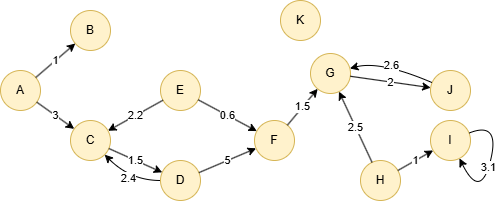
Run the following statements on an empty graph to define its structure and insert data:
ALTER EDGE default ADD PROPERTY { score float }; INSERT (A:default {_id: "A"}), (B:default {_id: "B"}), (C:default {_id: "C"}), (D:default {_id: "D"}), (E:default {_id: "E"}), (F:default {_id: "F"}), (G:default {_id: "G"}), (H:default {_id: "H"}), (I:default {_id: "I"}), (J:default {_id: "J"}), (K:default {_id: "K"}), (A)-[:default {score: 1}]->(B), (A)-[:default {score: 3}]->(C), (C)-[:default {score: 1.5}]->(D), (D)-[:default {score: 2.4}]->(C), (D)-[:default {score: 5}]->(F), (E)-[:default {score: 2.2}]->(C), (E)-[:default {score: 0.6}]->(F), (F)-[:default {score: 1.5}]->(G), (G)-[:default {score: 2}]->(J), (H)-[:default {score: 2.5}]->(G), (H)-[:default {score: 1}]->(I), (I)-[:default {score: 3.1}]->(I), (J)-[:default {score: 2.6}]->(G);
Creating HDC Graph
To load the entire graph to the HDC server hdc-server-1 as my_hdc_graph:
CREATE HDC GRAPH my_hdc_graph ON "hdc-server-1" OPTIONS { nodes: {"*": ["*"]}, edges: {"*": ["*"]}, direction: "undirected", load_id: true, update: "static" }
Parameters
Algorithm name: random_walk_node2vec
Name | Type | Spec | Default | Optional | Description |
|---|---|---|---|---|---|
ids | []_id | / | / | Yes | Specifies nodes to start random walk by their _id. If unset, computation includes all nodes. |
uuids | []_uuid | / | / | Yes | Specifies nodes to start random walk by their _uuid. If unset, computation includes all nodes. |
walk_length | Integer | ≥1 | 1 | Yes | Depth of each walk, i.e., the number of nodes to visit. |
walk_num | Integer | ≥1 | 1 | Yes | Number of walks to perform for each specified node. |
p | Float | >0 | 1 | Yes | The return parameter; a larger value reduces the probability of returning. |
q | Float | >0 | 1 | Yes | The in-out parameter; it tends to walk at the same level when the value is greater than 1, otherwise it tends to walk far away. |
edge_schema_property | []"<@schema.?><property>" | / | / | Yes | Numeric edge properties used as edge weights, summing values across the specified properties; edges without the specified properties are ignored. |
return_id_uuid | String | uuid, id, both | uuid | Yes | Includes _uuid, _id, or both values to represent nodes in the results. |
limit | Integer | ≥-1 | -1 | Yes | Limits the number of results returned. Set to -1 to include all results. |
File Writeback
algo(random_walk_node2vec).params({ projection: "my_hdc_graph", return_id_uuid: "id", walk_length: 6, walk_num: 2, p: 10000, q: 0.0001 }).write({ file:{ filename: 'walks' }})
Result:
File: walk_ids
J,G,F,D,C,E,
D,C,A,B,A,C,
F,G,E,C,A,B,
H,I,I,H,G,F,
B,A,C,D,F,G,
A,B,A,B,A,C,
E,C,E,C,A,B,
K,
C,E,F,G,J,G,
I,I,H,G,F,E,
G,H,I,I,H,G,
J,G,F,D,C,E,
D,C,A,B,A,C,
F,E,C,D,F,E,
H,G,H,G,J,G,
B,A,C,D,F,G,
A,C,D,F,E,C,
E,C,E,C,A,B,
K,
C,A,B,A,C,D,
I,H,G,J,G,H,
G,H,I,I,H,G,
Full Return
exec{ algo(random_walk_node2vec).params({ return_id_uuid: "id", ids: ['J'], walk_length: 6, walk_num: 3, p: 2000, q: 0.001 }) as walks return walks } on my_hdc_graph
Result:
| _ids |
|---|
| ["J","G","F","D","C","E"] |
| ["J","G","J","G","F","D"] |
| ["J","G","J","G","H","I"] |
Stream Return
exec{ algo(random_walk_node2vec).params({ return_id_uuid: "id", ids: ['A'], walk_length: 5, walk_num: 10, p: 1000, q: 1, edge_schema_property: 'score' }).stream() as walks return walks } on my_hdc_graph
Result:
| _ids |
|---|
| ["A","C","A","D","C"] |
| ["A","C","A","C","A"] |
| ["A","C","A","D","A"] |
| ["A","C","A","C","A"] |
| ["A","C","A","D","E"] |
| ["A","C","A","D","E"] |
| ["A","C","A","B","A"] |
| ["A","C","A","D","A"] |
| ["A","C","A","C","D"] |
| ["A","C","A","C","A"] |