
ArticleRank
HDC
Overview
ArticleRank has been derived from PageRank to measure the influence of journal articles.
- J. Li, P. Willett, ArticleRank: a PageRank-based Alternative to Numbers of Citations for Analysing Citation Networks (2009)
Concepts
ArticleRank
Like links between webpages, citations between articles (e.g., books or reports) indicate authority and quality. It is generally assumed that the more citations an article receives, the greater its perceived impact within its research domain.
However, not all articles are equally important. Hence, this approach based on PageRank was proposed to rank articles.
ArticleRank retains the basic PageRank methodology while making some modifications. When an article passes its rank among its forward links, it does not divide the rank equally by the out-degree of that article, but by the sum of the out-degree of that article and the average out-degree of all articles. The rank of article u after one iteration is:

where Bu is the backlink set of u, d is the damping factor. This change in the denominator reduces the bias that makes articles with few out-links seem to contribute more to their forward links.
NOTEThe denominator of Ultipa's ArticleRank is different from the original paper while the core idea is the same.
Considerations
In comparison with WWW, some features have to be considered for citation networks, such as:
- An article cannot cite itself, i.e., there is no self-loop in the network.
- Mutual citations are not allowed; an article cannot be both a forward link and a backlink at the same time.
- Citations in a published article are fixed, meaning its forward links remain static.
Example Graph
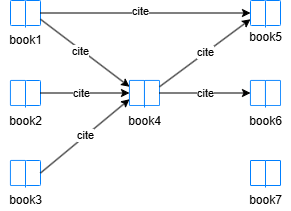
Run the following statements on an empty graph to define its structure and insert data:
ALTER GRAPH CURRENT_GRAPH ADD NODE { book () }; ALTER GRAPH CURRENT_GRAPH ADD EDGE { cite ()-[]->() }; INSERT (book1:book {_id: "book1"}), (book2:book {_id: "book2"}), (book3:book {_id: "book3"}), (book4:book {_id: "book4"}), (book5:book {_id: "book5"}), (book6:book {_id: "book6"}), (book7:book {_id: "book7"}), (book1)-[:cite]->(book4), (book1)-[:cite]->(book5), (book2)-[:cite]->(book4), (book3)-[:cite]->(book4), (book4)-[:cite]->(book5), (book4)-[:cite]->(book6);
Creating HDC Graph
To load the entire graph to the HDC server hdc-server-1 as my_hdc_graph:
CREATE HDC GRAPH my_hdc_graph ON "hdc-server-1" OPTIONS { nodes: {"*": ["*"]}, edges: {"*": ["*"]}, direction: "undirected", load_id: true, update: "static" }
Parameters
Algorithm name: page_rank
Name | Type | Spec | Default | Optional | Description |
|---|---|---|---|---|---|
init_value | Float | >0 | 0.2 | Yes | The initial rank assigned to all nodes. |
loop_num | Integer | ≥1 | 5 | Yes | The maximum number of iteration rounds. The algorithm terminates after all iterations are completed. |
damping | Float | (0,1) | 0.8 | Yes | The damping factor. |
weaken | Integer | 1, 2 | 1 | Yes | Keeps it as 2 for ArticleRank. Sets to 1 will run PageRank. |
return_id_uuid | String | uuid, id, both | uuid | Yes | Includes _uuid, _id, or both values to represent nodes in the results. |
limit | Integer | ≥-1 | -1 | Yes | Limits the number of results returned; -1 includes all results. |
order | String | asc, desc | / | Yes | Sorts the results by rank. |
File Writeback
algo(page_rank).params({ projection: "my_hdc_graph", return_id_uuid: "id", init_value: 1, loop_num: 50, damping: 0.8, weaken: 2, order: "desc" }).write({ file: { filename: "article_rank" } })
Result:
File: article_rank_id,rank
book4,0.428308
book5,0.375926
book6,0.319926
book2,0.2
book3,0.2
book7,0.2
book1,0.2
DB Writeback
Writes the rank values from the results to the specified node property. The property type is float.
algo(page_rank).params({ projection: "my_hdc_graph", loop_num: 50, weaken: 2 }).write({ db:{ property: 'rank' } })
Full Return
exec{ algo(page_rank).params({ return_id_uuid: "id", init_value: 1, loop_num: 50, damping: 0.8, weaken: 2, order: "desc", limit: 3 }) as AR return AR } on my_hdc_graph
Result:
| _id | rank |
|---|---|
| book4 | 0.428308 |
| book5 | 0.375926 |
| book6 | 0.319926 |
Stream Return
exec{ algo(page_rank).params({ return_id_uuid: "id", loop_num: 50, damping: 0.8, weaken: 2, order: "desc", limit: 3 }).stream() as AR return AR } on my_hdc_graph
Result:
| _id | rank |
|---|---|
| book4 | 0.428308 |
| book5 | 0.375926 |
| book6 | 0.319926 |