
Path Functions
Example Graph
The following examples run against this graph:

nodes()
Extracts all nodes from a path as a list. Supports index access and slicing.
| Syntax | nodes(<pathVar>) | ||
| Arguments | Name | Type | Description |
<pathVar> | PATH | Path variable reference | |
| Return Type | LIST<NODE> | ||
GQLMATCH p = ({_id: "P1"})-[]->{1,2}()
RETURN nodes(p)
Index access (0-based, negative indices supported):
GQLMATCH p = ({_id: "P1"})-[]->{2}()
RETURN nodes(p)[0] AS first, nodes(p)[-1] AS last
Slicing:
GQLMATCH p = ({_id: "P1"})-[]->{3}()
RETURN nodes(p)[0:2] AS first_two, nodes(p)[1:] AS rest
path_length()
Returns the number of edges in a path.
| Syntax | path_length(<pathVar>) | ||
| Arguments | Name | Type | Description |
<pathVar> | PATH | Path variable reference | |
| Return Type | UINT | ||
GQLMATCH p = ()->{1,3}()
RETURN p, PATH_LENGTH(p) AS length
Result:
| p | length |
|---|---|
 | 2 |
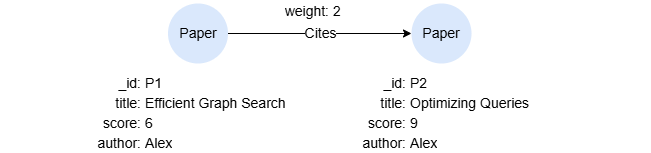 | 1 |
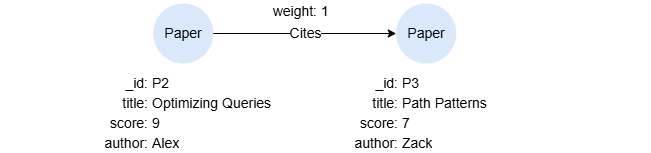 | 1 |
pedges()
Collects edges in a path into a list.
| Syntax | pedges(<pathVar>) | ||
| Arguments | Name | Type | Description |
<pathVar> | PATH | Path variable reference | |
| Return Type | LIST | ||
GQLMATCH p = ({_id: "P1"})-[]->{1,2}()
RETURN pedges(p)
Result:
| pedges(p) |
|---|
| [{"from":"P1","to":"P2","uuid":"1","from_uuid":"8791028671650463745","to_uuid":"8718971077612535810","schema":"Cites","values":{"weight":2}}] |
| [{"from":"P1","to":"P2","uuid":"1","from_uuid":"8791028671650463745","to_uuid":"8718971077612535810","schema":"Cites","values":{"weight":2}},{"from":"P2","to":"P3","uuid":"2","from_uuid":"8718971077612535810","to_uuid":"12033620403357220867","schema":"Cites","values":{"weight":1}}] |
pedgeUuids()
Collects the _uuid values of edges in a path into a list.
| Syntax | pedgeUuids(<pathAlias>) | ||
| Arguments | Name | Type | Description |
<pathAlias> | PATH | Path alias reference | |
| Return Type | LIST | ||
GQLMATCH p = ({_id: "P1"})-[]->{1,2}()
RETURN pedgeUuids(p)
Result:
| pedgeUuids(p) |
|---|
| ["1"] |
| ["1","2"] |
pnodes()
Collects nodes in a path into a list.
| Syntax | pnodes(<pathVar>) | ||
| Arguments | Name | Type | Description |
<pathVar> | PATH | Path variable reference | |
| Return Type | LIST | ||
GQLMATCH p = ({_id: "P1"})-[]->{1,2}()
RETURN pnodes(p)
Result:
| pnodes(p) |
|---|
| [{"id":"P1","uuid":"8791028671650463745","schema":"Paper","values":{"author":"Alex","title":"Efficient Graph Search","score":6}},{"id":"P2","uuid":"8718971077612535810","schema":"Paper","values":{"author":"Alex","title":"Optimizing Queries","score":9}}] |
| [{"id":"P1","uuid":"8791028671650463745","schema":"Paper","values":{"author":"Alex","title":"Efficient Graph Search","score":6}},{"id":"P2","uuid":"8718971077612535810","schema":"Paper","values":{"author":"Alex","title":"Optimizing Queries","score":9}},{"id":"P3","uuid":"12033620403357220867","schema":"Paper","values":{"author":"Zack","title":"Path Patterns","score":7}}] |
pnodeIds()
Collects the _id values of nodes in a path into a list.
| Syntax | pnodeIds(<pathAlias>) | ||
| Arguments | Name | Type | Description |
<pathAlias> | PATH | Path alias reference | |
| Return Type | LIST | ||
GQLMATCH p = ({_id: "P1"})-[]->{1,2}()
RETURN pnodeIds(p)
Result:
| pnodeIds(p) |
|---|
| ["P1","P2"] |
| ["P1","P2","P3"] |
relationships()
Extracts all edges from a path as a list. Supports index access and slicing.
| Syntax | relationships(<pathVar>) | ||
| Arguments | Name | Type | Description |
<pathVar> | PATH | Path variable reference | |
| Return Type | LIST<EDGE> | ||
GQLMATCH p = ({_id: "P1"})-[]->{1,2}()
RETURN relationships(p)
Index access:
GQLMATCH p = ({_id: "P1"})-[]->{2}()
RETURN relationships(p)[0] AS first_edge
Relationship to Other Path Functions
| Function | Returns | Description |
|---|---|---|
nodes(p) | LIST<NODE> | All nodes in the path. |
relationships(p) | LIST<EDGE> | All edges in the path. |
pnodes(p) | LIST<NODE> | All nodes in the path (same as nodes()). |
pedges(p) | LIST<EDGE> | All edges in the path (same as relationships()). |
NOTE
nodes(p)[0].name(chained property access) is not supported. Usenodes(p)[0]to retrieve the node, then access properties separately.