
UltipaDocs
Products
Solutions
Resources
Company
Start Free Trial
UltipaDocs
Start Free Trial
  • Introduction
    • Overview
    • Node and Edge Patterns
    • Path Patterns
    • Quantified Paths
    • Shortest Paths
    • Graph Patterns
    • Overview
    • Typed Graph
    • Open Graph
    • Graph Sharding and Storage
    • Constraints
    • Unique Identifiers
    • INSERT
    • INSERT OVERWRITE
    • UPSERT
    • SET
    • REMOVE
    • DELETE
    • Query Composition
    • Result Table and Visualization
    • MATCH
    • OPTIONAL MATCH
    • FILTER
    • LET
    • FOR
    • ORDER BY
    • LIMIT
    • SKIP
    • CALL
    • RETURN
    • Composite Query
    • NEXT
    • All Functions
    • Scalar Functions
    • Path Functions
    • Aggregate Functions
    • Mathematical Functions
    • Trigonometric Functions
    • String Functions
    • List Functions
    • Datetime Functions
    • Spatial Functions
    • Label Functions
    • Record Functions
    • Table Functions
  • Operators
  • Predicates
    • CASE
    • NULLIF
    • COALESCE
    • LET Value Expression
    • Value Query Expression
    • Index
    • Full-text Index
    • Vector Index
    • Spatial Index
    • Overview
    • Managing HDC Graphs
    • HDC Graph Queries
  • Transaction
  • Trigger
  • Stored Procedure
    • Process
    • Session
    • Job
    • Execution Plan
    • Variables
    • Values and Types
    • Comments
    • Reserved Words
    • Syntactic Notation
  • Access Control
  • GQL Conformance
  1. Docs
  2. /
  3. ISO GQL
  4. /
  5. Expressions

COALESCE

The COALESCE expression is a conditional expression that returns the first non-null value from a list of provided expressions. This is useful for substituting a default value when encountering null values, especially in scenarios where you want to avoid null results in calculations or display.

Syntax
<coalesce expression> ::=
  "COALESCE" "(" <value expression> { "," <value expression> }... ")"

The COALESCE(V1, V2, V3) expression is equivalent to the following CASE expression:

CASE Expression
CASE
  WHEN NOT V1 IS NULL THEN V1
  WHEN NOT V2 IS NULL THEN V2
  ELSE V3
END

Example Graph

The following examples run against this graph:
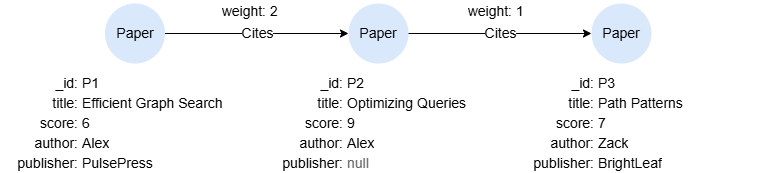
To create this graph, run the following query against an empty graph:

GQL
ALTER GRAPH CURRENT_GRAPH ADD NODE {
    Paper ({title string, score int32, author string, publisher string})
};
ALTER GRAPH CURRENT_GRAPH ADD EDGE {
    Cites ()-[{weight int32}]->()
};
INSERT (p1:Paper {_id:'P1', title:'Efficient Graph Search', score:6, author:'Alex', publisher:'PulsePress'}),
       (p2:Paper {_id:'P2', title:'Optimizing Queries', score:9, author:'Alex'}),
       (p3:Paper {_id:'P3', title:'Path Patterns', score:7, author:'Zack', publisher:'BrightLeaf'}),
       (p1)-[:Cites {weight:2}]->(p2),
       (p2)-[:Cites {weight:1}]->(p3)

Example

GQL
MATCH (n:Paper)
RETURN n.title, COALESCE(n.publisher, "N/A") AS publisher

Result:

n.titlepublisher
Efficient Graph SearchPulsePress
Optimizing QueriesN/A
Path PatternsBrightLeaf