
UltipaDocs
Try Playground
  • Introduction
  • Terminologies
    • Reserved Words
    • Data Types
    • Alias
    • Operators
    • Expression
    • Filter
    • Prefix
    • Node and Edge Templates
    • Homologous and Heterologous Data
    • Clause Execution Times
    • Graphset
    • Schema
    • Property
    • Insert
    • Overwrite
    • Upsert
    • Update
    • Delete
    • Find Nodes
    • Find Edges
      • AB
      • Autonet
      • Spread
      • Path Template
      • K-Hop
      • K-Hop Template
    • Find Subgraphs
    • GROUP BY
    • ORDER BY
    • SKIP
    • LIMIT
    • WHERE
    • RETURN
    • WITH
    • UNCOLLECT
    • UNION
    • UNION ALL
    • CALL
    • BATCH
      • Schema Checker
      • Equal
      • Not Equal
      • Less Than
      • Greater Than
      • Less Than or Equal
      • Greater Than or Equal
      • Between
      • Between or Equal
      • Beong to
      • Not Belong To
      • CONTAINS | String
      • CONTAINS | Full-Text
      • Regular Match
      • IS NULL
      • IS NOT NULL
      • And
      • Or
      • Not
      • Exclusive OR
      • DISTINCT
      • toString()
      • toInteger()
      • toFloat()
      • toDouble()
      • toDecimal()
      • toSet()
      • castToRaw()
      • now()
      • dateAdd()
      • dateDiff()
      • year()
      • month()
      • day()
      • dayOfWeek()
      • dateFormat()
      • point()
      • distance()
      • pointInPolygon()
      • lower()
      • upper()
      • reverse()
      • startsWith()
      • endsWith()
      • JSON_decode()
      • JSON_merge()
      • trim()
      • ltrim()
      • rtrim()
      • left()
      • right()
      • substring()
      • replace()
      • split()
      • intersection()
      • difference()
      • listUnion()
      • size()
      • head()
      • reduce()
      • listContains()
      • append()
      • pi()
      • pow()
      • sqrt()
      • abs()
      • floor()
      • ceil()
      • round()
      • sin()
      • cos()
      • tan()
      • cot()
      • asin()
      • acos()
      • atan()
      • length()
      • pnodes()
      • pedges()
      • count()
      • sum()
      • max()
      • min()
      • avg()
      • stddev()
      • collect()
      • dedup()
      • CASE
      • table()
      • coalesce()
      • ifnull()
    • Acceleration
    • Index
    • Full-text
    • LTE
    • Real-time Process
    • Backend Task
    • Analytics Node
    • Server Statistics
    • Server Backup
    • Privilege
    • Policy
    • User
  • Trigger
  1. Docs
  2. /
  3. UQL
  4. /
  5. Queries

UNION ALL

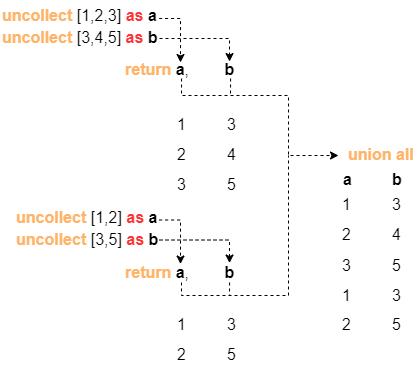
UNION ALL splices return values that have same alias from two RETURNs head-to-tail and unite the data of each return value in the same row as an integrated row. It has an operational efficiency higher than that of UNION since no deduplication is executed against the united rows.

Syntax:
... RETURN <expression1_A> as <alias_A>, <expression1_B> as <alias_B>, ...
UNION ALL
... RETURN <expression2_A> as <alias_A>, <expression2_B> as <alias_B>, ...
Input:

  • <expression1>: Return values of the 1st RETURN
  • <expression2>: Return values of the 2nd RETURN, should have the same number of return values as the 1st RETURN and the same data structure of each same alias
  • <alias>: The alias of return value (different order allowed)

For instance, splice heterologous return values a and b:
UQL
uncollect [1,2,3]) as a
uncollect [3,4,5]) as b
return a, b
union all
uncollect [1,2]) as a
uncollect [3,5]) as b
return a, b

Sample graph: (to be used for the following examples)
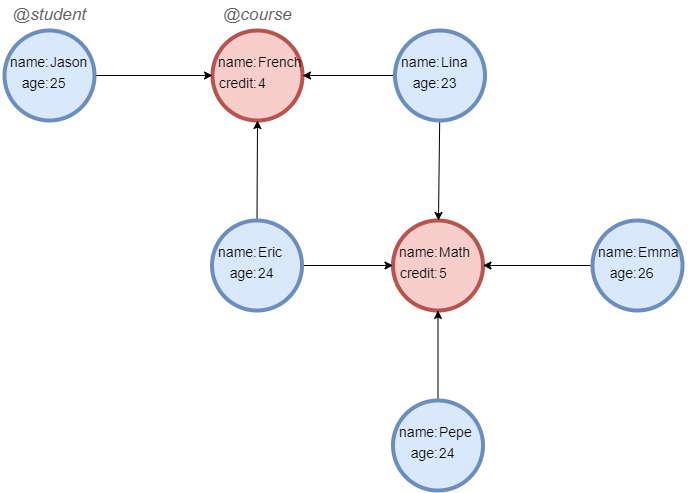
Run below UQLs one by one to in an empty graphset to create graph data: ```customlang___fold__lang_uql create().node_schema("student").node_schema("course") create().node_property(@*, "name").node_property(@student, "age", int32).node_property(@course, "credit", int32) insert().into(@student).nodes([{_id:"S001", _uuid:1, name:"Jason", age:25}, {_id:"S002", _uuid:2, name:"Lina", age:23}, {_id:"S003", _uuid:3, name:"Eric", age:24}, {_id:"S004", _uuid:4, name:"Emma", age:26}, {_id:"S005", _uuid:5, name:"Pepe", age:24}]) insert().into(@course).nodes([{_id:"C001", _uuid:6, name:"French", credit:4}, {_id:"C002", _uuid:7, name:"Math", credit:5}]) insert().into(@default).edges([{_uuid:1, _from_uuid:1, _to_uuid:6}, {_uuid:2, _from_uuid:2, _to_uuid:6}, {_uuid:3, _from_uuid:3, _to_uuid:6}, {_uuid:4, _from_uuid:2, _to_uuid:7}, {_uuid:5, _from_uuid:3, _to_uuid:7}, {_uuid:6, _from_uuid:4, _to_uuid:7}, {_uuid:7, _from_uuid:5, _to_uuid:7}]) ```

Common Usage

Example: Find students no elder than 24-year-old that select French, also find students no younger than 24-year-old that select Math, return these students

UQL
n({@course.name == "French"}).e().n({@student.age <= 24} as n) return n.name
union all
n({@course.name == "Math"}).e().n({@student.age >= 24} as n) return n.name
Result
Lina
Eric
Pepe
Eric
Emma