
Path Template
A path template n().e()...n() can apply filters on each node and edge of a path independently. Paths with circle can be filtered out, and the number of result of subquery can be limited.
NOTEFor the usage of basic templates
n(),e()and so on, please refer to Basic Templates.
Syntax:
- Statement alias: supported (PATH)
- Prefix: OPTIOANL (returns a path whose nodes and edges are all
nullfor any subquery that finds no result) - Optional parameters:
| Parameter | Type | Specification | Description | Structure of Custom Alias |
|---|---|---|---|---|
no_circle() | / | / | To dismiss the paths with circles; see Basic Concept - Terminologies for the definition of circle | Not supported |
limit() | Int | -1 or >=0 | Number of results to return for each subquery, -1 means to return all results | Not supported |
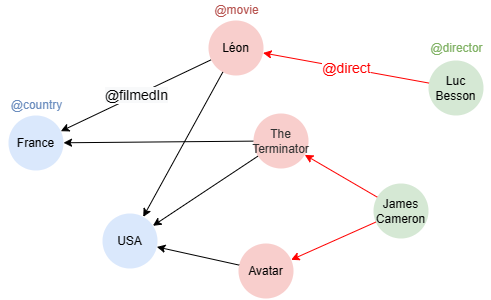
Sample graph: (to be used for the following examples)
Filter Single Node/Edge
Example: Find single-node paths of @movie, carry all properties
UQLn({@movie}) as p
return p{*}
ResultLéon
Avatar
The Terminator
Example: Find 4-step paths of @movie-@country-@movie-@director-@movie, carry all properties
UQLn({@movie}).re({@filmedIn}).n({@country})
  .le({@filmedIn}).n({@movie})
  .le({@direct}).n({@director})
  .re({@direct}).n({@movie}) as p
return p{*}
ResultLéon ----> France <---- The Terminator <---- James Cameron ----> Avatar
Léon ----> USA <---- The Terminator <---- James Cameron ----> Avatar
Léon ----> USA <---- Avatar <---- James Cameron ----> The Terminator
The Terminator ----> USA <---- Avatar <---- James Cameron ----> The Terminator
Avatar ----> USA <---- The Terminator <---- James Cameron ----> Avatar
Filter Multi-Edge
Example: Find 1~4-step paths from Léon to Avatar, carry all properties
UQLn({@movie.name == "Léon"}).e()[:4].n({@movie.name == "Avatar"}) as p
return p{*}
ResultLéon ----> France <---- The Terminator ----> USA <---- Avatar
Léon ----> France <---- The Terminator <---- James Cameron ----> Avatar
Léon ----> USA <---- The Terminator <---- James Cameron ----> Avatar
Léon ----> USA <---- Avatar
Filter Multi-Edge and Intermediate Nodes
Example: Find 1~4-step paths from Léon to Avatar and not passing France, carry all properties
UQLn({@movie.name == "Léon"}).e().nf({name != "France"})[:4].n({@movie.name == "Avatar"}) as p
return p{*}
ResultLéon ----> USA <---- The Terminator <---- James Cameron ----> Avatar
Léon ----> USA <---- Avatar
Non-weighted Shortest Path
Example: Find shortest paths from Léon to Avatar within 4 steps, carry all properties
UQLn({@movie.name == "Léon"}).e()[*:4].n({@movie.name == "Avatar"}) as p
return p{*}
ResultLéon ----> USA <---- Avatar
Analysis: The multi-edge template e()[*:N] or e().nf()[*:N] that represent shortest path must be the last edge template in the path.
Filter Circle
Example: Find 4-step paths of @movie-@country-@movie-@director-@movie, with the initial-node and terminal-node representing the same node, carry all properties
UQLn({@movie} as a).re({@filmedIn}).n({@country})
  .le({@filmedIn}).n({@movie})
  .le({@direct}).n({@director})
  .re({@direct}).n(a) as p
return p{*}
ResultThe Terminator ----> USA <---- Avatar <---- James Cameron ----> The Terminator
Avatar ----> USA <---- The Terminator <---- James Cameron ----> Avatar
Example: Find 4-step paths of @movie-@country-@movie-@director-@movie, remove paths with circles, carry all properties
UQLn({@movie}).re({@filmedIn}).n({@country})
  .le({@filmedIn}).n({@movie})
  .le({@direct}).n({@director})
  .re({@direct}).n({@movie}).no_circle() as p
return p{*}
ResultLéon ----> France <---- The Terminator <---- James Cameron ----> Avatar
Léon ----> USA <---- The Terminator <---- James Cameron ----> Avatar
Léon ----> USA <---- Avatar <---- James Cameron ----> The Terminator
limit()
Example: Find two 4-step paths of @movie-@country-@movie-@director-@movie, carry all properties
UQLn({@movie}).re({@filmedIn}).n({@country})
  .le({@filmedIn}).n({@movie})
  .le({@direct}).n({@director})
  .re({@direct}).n({@movie}).limit(2) as p
return p{*}
ResultLéon ----> France <---- The Terminator <---- James Cameron ----> Avatar
Léon ----> USA <---- The Terminator <---- James Cameron ----> Avatar
OPTIONAL
Example: Find 2-step paths from Luc Besson to Avatar, carry all properties; return null if no result
UQLoptional n({@director.name == "Luc Besson"}).e()[2].n({@movie.name == "Avatar"}) as p
return p{*}
Resultnull --null-- null --null-- null
Analysis: This query will give no return if not using OPTIONAL.
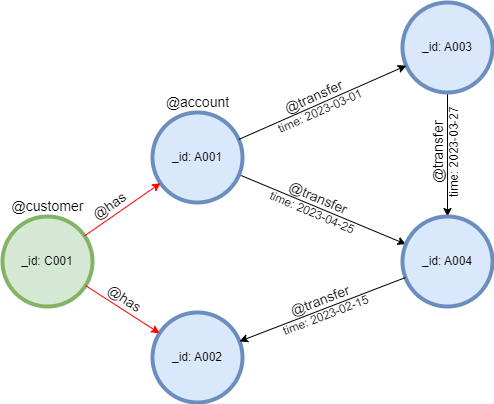
Sample graph: (to be used for the following examples)
Filter 0 Step
Example: Find 0~2-step outward-transferring paths from the accounts held by C001 to other accounts, carry all properties
UQLn({_id == "C001"}).re({@has}).n({@account})
  .re({@transfer})[0:2].n({@account}) as p
return p{*}
ResultC001 ----> A001
C001 ----> A001 ----> A003
C001 ----> A001 ----> A003 ----> A004
C001 ----> A001 ----> A004
C001 ----> A001 ----> A004 ----> A002
C001 ----> A002
Analysis: The 0-step in multi-edge template e()[0:N] or e().nf()[0:N] works only when both n() before and after this multi-edge template have same filtering condition.
Inter-Step Filtering
Example: Find 2-step outward-transferring paths between accounts, with property time ascending along the path, carry all properties
UQLn({@account}).re({@transfer.time > prev_e.time})[2].n({@account}) as p
return p{*}
ResultA001 ----> A003 ----> A004
Analysis: Porperty @transfer.time should be loaded to engine (LTE).