
intersection()
Function intersection() calculates the common elements of two lists and returns them as a new list, namely, returns the intersection of these two lists (repeated elements are allowed in the intersection).
Arguments:
- 1st list <list>
- 2nd list <list>
Returns:
- Intersection <list>
Common Usage
Example: Direct calculate
UQLuncollect [[1,2,2],[2,4,5]] as a
uncollect [[2,4,7],[4,5,7]] as b
return table(toString(a), toString(b), toString(intersection(a, b)))
Result| toString(a) | toString(b) | toString(intersection(a, b)) |
|-------------|-------------|------------------------------|
| [1,2,2]     | [2,4,7]     | [2]                          |
| [2,4,5]     | [4,5,7]     | [4,5]                        |
Example: Multiply and calculate
UQLuncollect [[1,2,2],[2,4,5]] as a
uncollect [[2,4,7],[4,5,7]] as b
with intersection(a, b) as c
return table(toString(a), toString(b), toString(c))
Result| toString(a) | toString(b) | toString(c) |
|-------------|-------------|-------------|
| [1,2,2]     | [2,4,7]     | [2]         |
| [1,2,2]     | [4,5,7]     | []          |
| [2,4,5]     | [2,4,7]     | [2,4]       |
| [2,4,5]     | [4,5,7]     | [4,5]       |
Sample graph: (to be used for the following examples)
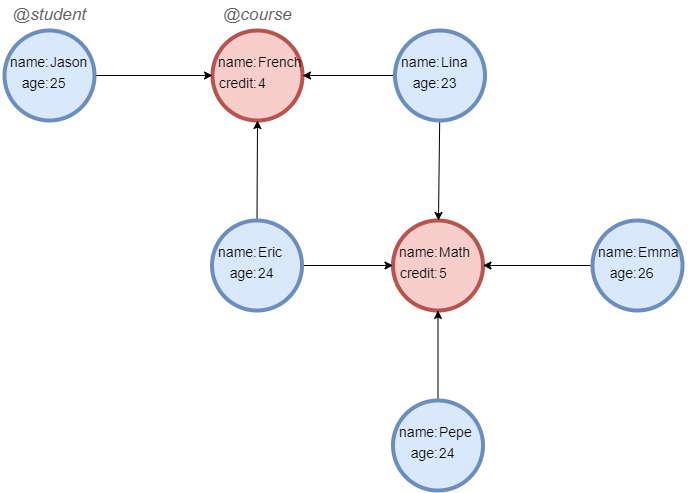
Example: Find the students that select both French and Math
UQLkhop().src({name == "French"}).depth(1) as n1
with collect(n1) as l1
khop().src({name == "Math"}).depth(1) as n2
with collect(n2) as l2
return intersection(l1, l2)
Result[
  {"id":"","uuid":"2","schema":"student","values":{}},
  {"id":"","uuid":"3","schema":"student","values":{}}
]