
Delete
Overview
The delete() clause is used to delete nodes or edges that meet the given conditions. It's important to note that deleting a node leads to the removal of all edges that are connected to it.
The delete operation is irreversible.
Syntax
Syntax// Delete nodes
delete().nodes(<filter>).limit(<N>)

// Delete edges
delete().edges(<filter>).limit(<N>)
- The nodes or edges to be deleted must meet the conditions specified in the
nodes()oredges()method. Leave it blank to specify all nodes or edges. - Optionally use the
limit()method to restrict the number of nodes or edges to delete. - Not allowed to define an alias for the clause.
Example Graph
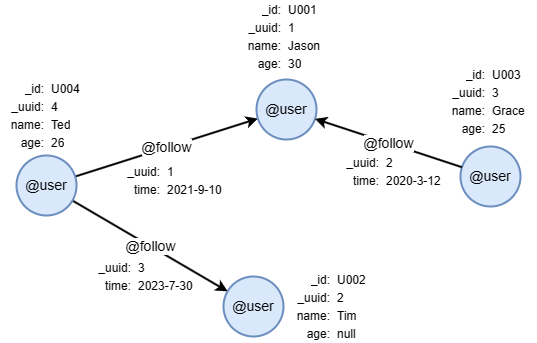
Run these UQLs row by row in an empty graphset to create this graph:
UQLcreate().node_schema("user").edge_schema("follow")
create().node_property(@user, "name").node_property(@user, "age", int32).edge_property(@follow, "time", datetime)Click to expand
Examples
Delete Nodes
UQLdelete().nodes({name == "Grace"})
The node with _id U003 is deleted, along with the edge with _uuid 2.
Delete Edges
UQLdelete().edges({@follow})
All @follow edges are deleted.
Delete Limited Nodes
UQLdelete().nodes({@user.age > 26}).limit(2)
This deletes the @user nodes whose age property values are greater than 26, limited to two nodes.