
UltipaDocs
Try Playground
  • Introduction
  • Terminologies
    • Reserved Words
    • Data Types
    • Alias
    • Operators
    • Expression
    • Filter
    • Prefix
    • Node and Edge Templates
    • Homologous and Heterologous Data
    • Clause Execution Times
    • Graphset
    • Schema
    • Property
    • Insert
    • Overwrite
    • Upsert
    • Update
    • Delete
    • Find Nodes
    • Find Edges
      • AB
      • Autonet
      • Spread
      • Path Template
      • K-Hop
      • K-Hop Template
    • Find Subgraphs
    • GROUP BY
    • ORDER BY
    • SKIP
    • LIMIT
    • WHERE
    • RETURN
    • WITH
    • UNCOLLECT
    • UNION
    • UNION ALL
    • CALL
    • BATCH
      • Schema Checker
      • Equal
      • Not Equal
      • Less Than
      • Greater Than
      • Less Than or Equal
      • Greater Than or Equal
      • Between
      • Between or Equal
      • Beong to
      • Not Belong To
      • CONTAINS | String
      • CONTAINS | Full-Text
      • Regular Match
      • IS NULL
      • IS NOT NULL
      • And
      • Or
      • Not
      • Exclusive OR
      • DISTINCT
      • toString()
      • toInteger()
      • toFloat()
      • toDouble()
      • toDecimal()
      • toSet()
      • castToRaw()
      • now()
      • dateAdd()
      • dateDiff()
      • year()
      • month()
      • day()
      • dayOfWeek()
      • dateFormat()
      • point()
      • distance()
      • pointInPolygon()
      • lower()
      • upper()
      • reverse()
      • startsWith()
      • endsWith()
      • JSON_decode()
      • JSON_merge()
      • trim()
      • ltrim()
      • rtrim()
      • left()
      • right()
      • substring()
      • replace()
      • split()
      • intersection()
      • difference()
      • listUnion()
      • size()
      • head()
      • reduce()
      • listContains()
      • append()
      • pi()
      • pow()
      • sqrt()
      • abs()
      • floor()
      • ceil()
      • round()
      • sin()
      • cos()
      • tan()
      • cot()
      • asin()
      • acos()
      • atan()
      • length()
      • pnodes()
      • pedges()
      • count()
      • sum()
      • max()
      • min()
      • avg()
      • stddev()
      • collect()
      • dedup()
      • CASE
      • table()
      • coalesce()
      • ifnull()
    • Acceleration
    • Index
    • Full-text
    • LTE
    • Real-time Process
    • Backend Task
    • Analytics Node
    • Server Statistics
    • Server Backup
    • Privilege
    • Policy
    • User
  • Trigger
  1. Docs
  2. /
  3. UQL
  4. /
  5. Queries

CALL

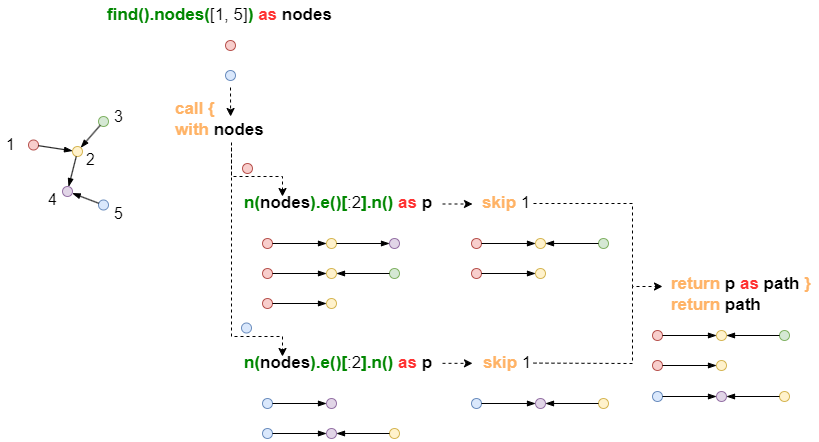
CALL executes operations against the query result of each subquery, NOT all the result of a query command. It wraps query commands and the operations in curly braces {}, passes in the alias that triggers each subquery using a WITH clause and passes out the result of each subquery using a RETURN clause.

Syntax:
CALL {
  WITH <alias_In>, <alias_In>, ...
  ...
  RETURN <expression> as <alias_Out>, <expression> as <alias_Out>, ...
} Input:

  • <alias_In>: The alias that triggers the subquery
  • <expression>: The return value of the subquery
  • <alias_Out>: The alias of return value of the subquery, optional when <expression> is alias

For instance, skip the first row of each subquery result p:
UQL
find().nodes([1, 5]) as nodes
call {
  with nodes
  n(nodes).e()[:2].n() as p
  skip 1
  return p as path
}
return path

Sample graph: (to be used for the following examples)
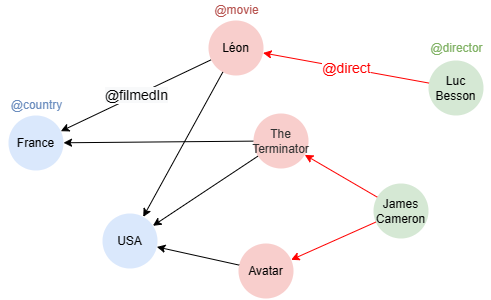
Run below UQLs one by one to in an empty graphset to create graph data: ```customlang___fold__lang_uql create().node_schema("country").node_schema("movie").node_schema("director").edge_schema("filmedIn").edge_schema("direct") create().node_property(@*, "name") insert().into(@country).nodes([{_id:"C001", _uuid:1, name:"France"}, {_id:"C002", _uuid:2, name:"USA"}]) insert().into(@movie).nodes([{_id:"M001", _uuid:3, name:"Léon"}, {_id:"M002", _uuid:4, name:"The Terminator"}, {_id:"M003", _uuid:5, name:"Avatar"}]) insert().into(@director).nodes([{_id:"D001", _uuid:6, name:"Luc Besson"}, {_id:"D002", _uuid:7, name:"James Cameron"}]) insert().into(@filmedIn).edges([{_uuid:1, _from_uuid:3, _to_uuid:1}, {_uuid:2, _from_uuid:4, _to_uuid:1}, {_uuid:3, _from_uuid:3, _to_uuid:2}, {_uuid:4, _from_uuid:4, _to_uuid:2}, {_uuid:5, _from_uuid:5, _to_uuid:2}]) insert().into(@direct).edges([{_uuid:6, _from_uuid:6, _to_uuid:3}, {_uuid:7, _from_uuid:7, _to_uuid:4}, {_uuid:8, _from_uuid:7, _to_uuid:5}]) ```

Common Usage

Example: Not using GROUP BY, find how many movies are filmed in each country

UQL
find().nodes({@country}) as nodes
call { 
  with nodes
  n(nodes).e().n({@movie} as n)
  return count(n) as number
}
return table(nodes.name, number)
Result
| nodes.name | number |
|------------|--------|
| France     | 2      |
| USA        | 3      |