
Belong to
- Expression:
<value>IN<list> - Left operand: string, number, time, list, point, NODE, EDGE
- Right operand: list
Constant
Example: Judge whether 2 belongs to [1,2,3]
UQLreturn 2 in [1,2,3]
Result1
Function
Example: Judge whether 2 belongs to the intersection of [1,2,3] and [3,2,5]
UQLreturn 2 in intersection([1,2,3], [3,2,5])
Result1
Alias
Example: Judge each row of an alias whether it belongs to [0,1,3]
UQLuncollect [1,2,3,2,2] as a
return a in [0,1,3]
Result1
0
1
0
0
Sample graph: (to be used for the following examples)
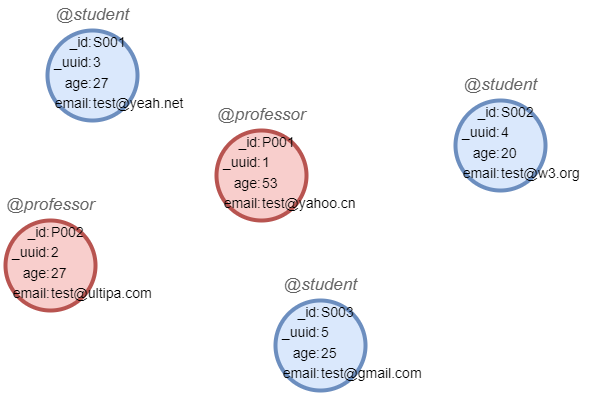
Property
Example: Find nodes whose age belongs to [20,25,30,35]
UQLfind().nodes({age in [20,25,30,35]}) as n
return n{*}
Result|---------------- @student ---------------|
|  _id  | _uuid |  age  |       email     |
|-------|-------|-------|-----------------|
| S002  |   4   |  20   | [email protected]     |
| S003  |   5   |  25   | [email protected]  |
Example: Find nodes of @professor, whose age belongs to [20,25,30,35]
UQLfind().nodes({@professor.age in [20,25,30,35]}) as n
return n{*}
ResultNo return data
_uuid (Abbreviated)
When a filter only judges whether the _uuid of the current node/edge belongs to a list of integers, the filter can be abbreviated as below:
| Standard Form | Abbreviated Form | Specification |
|---|---|---|
| ({ _uuid in [1,2,3]}) | ([1,2,3]) | |
({ _uuid in intList}) | (intList) | intList is the alias of an interger list |
({ _uuid in [node1._uuid, node2._uuid, ...]}) | (nodeList) | nodeList is the alias of [node1, node2, ...] |
({ _uuid in [edge1._uuid, edge2._uuid, ...]}) | (edgeList) | edgeList is the alias of [edge1, edge2, ...] |
Example: Find node whose _uuid belongs to [2,3,5]
UQLfind().nodes([2,3,5]) as n
return n{*}
Result|---------------- @student ---------------|
|  _id  | _uuid |  age  |       email     |
|-------|-------|-------|-----------------|
| S001  |   3   |  27   | [email protected]   |
| S002  |   4   |  20   | [email protected]     |
| S003  |   5   |  25   | [email protected]  |